Showing posts with label amber oriental. Show all posts
Saturday, March 16, 2013
Belle of the Barnyard: Max Factor Epris
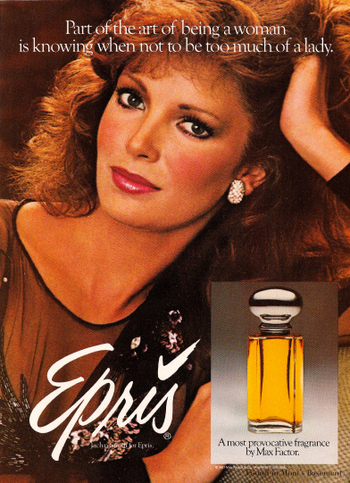
If I'd been looking for a spokeswoman in the eighties, and had a sultry perfume to sell, Jaclyn Smith wouldn't have been my first (or second) choice. While not exactly strawberry shortcake, she was never really the let's get right into bed type. Had I seen the Jaclyn-centric ad for Epris before smelling this 1981 Max Factor fragrance, I doubt my curiosity would have been triggered. Fortunately, I found a mini at some antique store last summer, traveling cross country with my mom (I don't advise this, by the way, unless you can keep your travel time down to under five hours or you're going convoy style in separate cars).
Until a week ago, I enjoyed this mini periodically but had no idea what it was, and much as I liked it, I didn't really investigate. I don't think I even checked the bottom of the bottle, where the label indicates the name. I assumed it was some Youth Dew era oriental, a one off that didn't make a wave (though it clearly should have) and barely made a dent in the mass market culture of suburban perfume lovers. At some point I even thought it might actually have been decanted from a larger, more recognizable fragrance by another traveller who, like me, needed some back up on the road. Who knew Epris was listed on Fragrantica all this time, or that I could have very easily looked into it before now?
Fragrantica lists Epris as a chypre floral. My immediate thought, reading this, was that if Epris is a chypre floral, Bandit is a fruitchouli in a faceted pink bottle. Epris doesn't even smell like a floriental to me. It's straight up balsamic oriental, with the usual suspects hiking up their skirts: patchouli, spices (clove, clove, and clove) and a generous scraping of civet and castoreum. It has a leathery feel instantly, rather than drying down to one, and while there are florals in the mix, as in Youth Dew, they've obviously been told to sit down and shut up. This fragrance wants to get horizontal, and it wants to get horizontal now. After gymnastic somersaults through spiced amber and barnyard, it gets a little powdery in the late dry down, as if to say, "Yes, that's my bosom you're smelling."
"Maybe your mother never told you," begins the television ad, "there's more to being a woman than minding your manners." You might easily assume, hearing Jaclyn Smith say this, that she's just sucked on helium. Maybe it's the quality of the recording in the version I watched. Either way, as with the designation "chypre floral", there's a real disconnect between the way the fragrance is made to sound (girly) and the way it actually smells (far end of post pubescent: pun intended). "Being a woman means sometimes taking the first step first," Jaclyn continues, after introducing herself in a sequined, mostly sheer black dress reclining on a plump leather sofa. Again, I would say leap, not step, because Epris is clearly an attack mode type fragrance, with a physical vocabulary ranging from pounce to pulverize.
Epris, says Jaclyn, is a fragrance that understands this "first step first" thing. "Epris is a little unsettling; a little disturbing. Epris is a most provocative fragrance. If mama never told you, I'll tell you: Part of the art of being a woman is knowing when not to be too much of a lady."
Whatever the tone of her voice, at least the dialogue speaks truthfully about the perfume. While the initial impression of Epris is along the lines of Youth Dew, it soon takes a slight but hard left turn toward Tabu, putting itself in park somewhere in between. Even in an era characterized by bold, forceful constructions, Epris was something of an oddball, looking back lustfully not just to Youth Dew (1953) and Tabu (1932) but to one of my all time favorites, Bal a Versailles (1962). It dives straight down to patchouli and animalics without bothering to ask you if you mind. There's that kind of confidence in it. It's on the prowl and thanks you very much for letting it out of the bottle to get the ball rolling, but no time for niceties. It don't mind if it do.
There's a taste for this kind of thing, and not everyone's salivating over it. I'm grateful, because it's scarce online, unless you want to stock up on minis until you have something approximating full bottle. I'm impressed with everything about Epris - the fact that Max Factor produced it, its tenacity, its husky attitude, its uniqueness among its eighties peers as an old school, unapologetic oriental. It's been a long time since I smelled something this good, and I was happy to find a seller online who was offering two one ounce bottles. How much do I like Epris? Better than my favorite Serge Lutens fragrance (a tie between Cedre and Arabie, in case you're wondering). Once again, I'm reminded that some of the most satisfying fragrances have been sold at the drugstore, for a steal, and they didn't even have oud in them.
Labels:
amber oriental,
civet,
clove,
Estee Lauder Youth Dew,
Max Factor Epris,
Oriental,
Patchouli,
Tabu
Tuesday, March 5, 2013
Amber Alert: Ambre Dore by Maitre Parfumeur et Gantier
A few years ago, when I discovered that Bonwit Teller carried the Maitre Parfumeur et Gantier line, I bought a few of my favorites over the phone. At that point, it was hard to find some of the older MPG fragrances - like Eau des Iles, Parfum D'Habit, Camelia Chinois, and Ambre Precieux. Even the stores that did carry the line didn't seem to include such rarities in their inventory, and one day, talking to the sales associate, I discovered there was one so rare I'd never even heard of it. Soir d'Orient had been reviewed three times on Makeupalley.com and averaged a rating of four and a half. It was described at the time (pre oud craze) as a leather amber with smoked vanillic facets. And Bonwit Teller hadn't carried any in quite some time.
Fast forward to 2012, when MPG announced the release of a new fragrance called Ambre Dore. More than a few comments online remarked at the similarity of notes between Dore and D'Orient. Were they the same fragrance? The notes I could find for Soir d'Orient included amber, oud, and leather. The notes for Dore: essence of oud, ambergris, saffron, styrax resin, coriander, myrrh, and vetiver. Fragrantica eventually cleared the air with its listing for Dore. According to them, it was in fact a reissue of that 2006 rarity formerly known as Soir D'Orient. The craze for oud made this once special issue fragrance, exclusive to the Eastern market, now marketable to the rest of us.
My hopes were pretty high for Dore, as Soir D'Orient, its former incarnation, represented that now practically extinct thing in perfumery - something I wanted but couldn't get my hands on. And while almost no fragrance I can think of could possibly fulfill such built up expectations, Dore makes an admirable go of it.
The few reviews I've read commend Ambre Dore for its robust, animalic opening. If you consider oud animalic, they might be right. For me, it's a smooth, ambery melange which smells a little like leather but more like what we've all now pretty much agreed is "oud". Whether this is "oud essence", as MPG says, or good old fashioned cypriol I can't tell you, but it's pretty fantastic either way. I don't know what I would have made of this opening four or five years ago, before oud became so ubiquitous in niche perfumery that it might as well be fig or iris. I might have regarded Soir d'Orient as "slightly medicinal", which is how we were all describing oud back when it made its first, feeble bid for our attention. I wouldn't have helped support its journey West, I suspect.
By the time I finally caved and bought a bottle of Ambre Dore, I'd been searching for the near perfect amber for several months. Ambre Dore comes nearer to that near than anything else I've gotten my hands on. After its wonderfully rich opening, it settles down into a slight variation on the wonderful Ambre Precieux, with touches of resins and vanilla, a fairly old fashioned take on the classic amber fragrance, which is the kind of thing I like. Ambre Russe has this quality, to some degree, though it perks things up with apple. Lutens' Ambre Sultan, despite all the herbs, is pretty old fashioned. Still, Sultan is too much of a skin scent for me; Russe is wonderful in almost every way, and I can't tell you in just which way it isn't quite as wonderful as I'd like it to be. I like some amount of oomph in an amber, and some of my favorites, much as I love them, get a little too powdery a little too quickly. When they don't get powdery, they start to smell less like amber. Even once it mellows considerably, an hour or so in, Ambre Dore has that kind of weird, edgy quality it showed in the opening. It dries down as satisfyingly as it starts out, and for me it's amber bliss.
Even more than the amber, I love the oud, which has surprised me. Oud is so over-exploited now that I cringe at the sound of the word. Everyone has a wonderful new oud, which smells no more or less wonderful than the last. Oud seems to have finally given niche perfumery the excuse it was apparently looking for to boost its prices laughably high. It was a real dilemma: how do you package perfume in the same old bottle but charge more? Oud answered the question, however insipidly. You import "costly" oud "essences" from the East. We are now in the Baroque Oud period, where niche lines release their second, third, and even fourth oud fragrances. Their last oud smelled like every other, but they convince someone (if not me) that they have something new to say with the material, which is invariably synthetically composed, no matter the claims of faraway and hard to reach origins. Nothing is hard to reach anymore, but oud convinces us that state of covet versus lack still thrives, right under our noses.
Ambre Dore is an oud fragrance which doesn't scream oud. No mistake, you smell the oud in it, but it's incorporated as a supporting player - perhaps because Soir d'Orient came out at a time when oud wasn't something to write, let alone leave, home about. Ambre Dore used oud with the kind of subtlety that no modern oud release can really afford to, and wins me over for that. It's a pretty exceptional scent.
If anyone else has favorite ambers I'd love to know.
Friday, August 10, 2012
Parfums de Nicolaï: Number One Intense
There aren't many Parfums de Nicolaï fragrances I don't at least like a lot, and some, like Maharanih Intense, are among my favorites. Several of those I like most are a little more formally innovative or inventive than my ultimate favorite, Number One Intense. Vie de Chateau, for instance, with its curious hay note, is full of subtle, elegant herbal twists. Nicolaï Pour Homme always surprises me, somehow. And yet not one of these satisfies me more than Number One, which seems so pure and perfect in its way that I realize I'd rather be fulfilled sometimes than startled.
Number One was, aptly, my first Nicolaï purchase. Recently, at the Perfume House in Portland, where an older bottle was still in stock, a friend opened it and smelled it and nothing else seemed as good to me in the store. I remembered instantly how much I love it. I would classify Number One as an amber floriental I guess. For a while I thought it was a lot like Hermes 24, Faubourg, another amber floral which seems illuminated from within - until I compared the two side by side. They have a lot in common, but alongside Number One, 24 seems, if not shrill, then a little heavy on the treble. Faubourg seems more like a citrus cologne by comparison.
Number One was created in 1989, which makes sense, because that era produced a lot of my favorites. Like a lot of those '80s fragrances, Number One is rich to the point of plush, but where a lot of those scents have conjured the analogous big shouldered outfits of their time, Number One, despite all its voluble drama, feels softened and remarkably supple, a symphony heard through velvet. Part of this, I suspect, is the restraint shown with tuberose, which in many eighties frags becomes their sole reason for being. The tuberose in Number One plays nicely with the other florals - namely, jasmine, ylang ylang, rose, and orang blossom - allowing all of them to show something of themselves. There's a unique harmony to the fragrance.
The base of amber, oakmoss, and sandalwood shows, for me, the kind of durability and backbone emphasis most fragrances need a hefty dose of patchouli to achieve. Number One is the rare fragrance I imagine patchouli would have ruined rather than improved. And I like to think the use of tagetes up top gives it some level of distinction often lacking in its eighties brethren. The fragrance is perfectly judged and balanced and I couldn't imagine it any other way. It lasts all day on me, without, by the end of the day, feeling more like the day after.
I understand, I think, why it isn't discussed more often. Revisiting Number One recently started me thinking about the way we "review" fragrances. There are so many - so many in existence and so many emerging. It's easy to fall into judging them by what they do that something else hasn't, when sometimes, as with Number One, what they do different is simply, for a change, get it wonderfully right.
Painting: "Torrid Day" by Jane Wilson
Number One was, aptly, my first Nicolaï purchase. Recently, at the Perfume House in Portland, where an older bottle was still in stock, a friend opened it and smelled it and nothing else seemed as good to me in the store. I remembered instantly how much I love it. I would classify Number One as an amber floriental I guess. For a while I thought it was a lot like Hermes 24, Faubourg, another amber floral which seems illuminated from within - until I compared the two side by side. They have a lot in common, but alongside Number One, 24 seems, if not shrill, then a little heavy on the treble. Faubourg seems more like a citrus cologne by comparison.
Number One was created in 1989, which makes sense, because that era produced a lot of my favorites. Like a lot of those '80s fragrances, Number One is rich to the point of plush, but where a lot of those scents have conjured the analogous big shouldered outfits of their time, Number One, despite all its voluble drama, feels softened and remarkably supple, a symphony heard through velvet. Part of this, I suspect, is the restraint shown with tuberose, which in many eighties frags becomes their sole reason for being. The tuberose in Number One plays nicely with the other florals - namely, jasmine, ylang ylang, rose, and orang blossom - allowing all of them to show something of themselves. There's a unique harmony to the fragrance.
The base of amber, oakmoss, and sandalwood shows, for me, the kind of durability and backbone emphasis most fragrances need a hefty dose of patchouli to achieve. Number One is the rare fragrance I imagine patchouli would have ruined rather than improved. And I like to think the use of tagetes up top gives it some level of distinction often lacking in its eighties brethren. The fragrance is perfectly judged and balanced and I couldn't imagine it any other way. It lasts all day on me, without, by the end of the day, feeling more like the day after.
I understand, I think, why it isn't discussed more often. Revisiting Number One recently started me thinking about the way we "review" fragrances. There are so many - so many in existence and so many emerging. It's easy to fall into judging them by what they do that something else hasn't, when sometimes, as with Number One, what they do different is simply, for a change, get it wonderfully right.
Painting: "Torrid Day" by Jane Wilson
Saturday, December 10, 2011
Dior Mitzah
The recent 10 additions to Dior’s exclusive range have been met with lukewarm reviews at best. Each fragrance in Dior La Collection could easily be called “good” but what most perfume enthusiasts are reacting to is that fact that the exclusive range should, by definition, be a step above mainstream releases.
If Dior Mitzah was instead a new mainstream release from Dior, available at every Sephora worldwide, which is to say easy to find, and available in smaller less expensive bottles, I would think many perfume enthusiasts and bloggers would have sung its praises.
I’m going to put aside expectations of what a fragrance in Dior’s exclusive range should smell like and instead evaluate Mitzah as ‘any old’ perfume released in 2010. Here’s the thing: Dior Mitzah is a beautiful amber. It isn’t particularly unique and I’d classify it as a functional fragrance, but it’s one helluvah gorgeous and wearable amber oriental.
I’ve noticed myself leaning towards functional fragrances over the past year. In an effort to pare down my collection (somewhat) I’ve begun pinpointing those fragrances I love and readily wear from within each fragrance category. I have a lot of amber orientals. Over the years, amber orientals have been my truest love. Recently, a great number of my favorite amber fragrances suddenly smelled too sweet, a little cloying and very, very, musty-dusty to me. I can’t explain this change and believe me it was a pretty sad realization at first. What I’ve come to find is that I now require a very specific sort of amber fragrance. Ambers I love lately need to be fairly dry, slightly herbal, and not too heavy, with some spice and incense. The ambers I’ve been happy with this fall are Alahine, Histoires de Parfums Ambre 114, Agent Provocateur Strip, Calvin Klein Obsession and maybe one or two others I’m forgetting.
Dior Mitzah hits the spot perfectly. While it doesn’t break especially new ground, what it does for me is fix every other amber out there that’s either “too sweet” or “too heavy” or “too musty-dusty” or “too-foodie” and instead nails the perfect balance of what I think an amber oriental should be. Mitzah wears like a sheer veil instead of a blanket; it’s present yet light. Mitzah has touches of sweetness but it never reaches foodie realm. Mitzah avoids the musty-dusty aspect many ambers fall prey to (this might be due to “Ambre 83,” discussed more in two blogs listed below) . Mitzah is not a spice-fest like Ambre Sultan or Arabie, it’s much much (much) smoother. I’m telling you what it isn’t, but I should also tell that it is a velvety, dry, softly spicy herbaceous amber that is dreamy. I wasn’t blown away by Mitzah the first time I tried it because it’s quite similar to so many other ambers out there. Once you’ve smelled a few ambers, you pretty much get the idea, and everything that starts off like a typical amber seems a bit generic. Annick Goutal Ambre Fetiche and Serge Lutens Ambre Sultan might stick out from the pack because they are so bold. Mitzah isn’t bold; it’s tame, functional and effortlessly wearable. I think it's gorgeous.
Notes include: coriander, cinnamon, amber, rose, patchouli, incense, vanilla, and honey
Other reviews
Friday, January 2, 2009
Fendi Asja
Asja seems like an answer to a question Opium and Cinnabar started formulating over fifteen years after their arrival, a question they probably never intended to ask. How do you extend their balsamic depth, as intricately detailed as the panoramic relief on a red lacquered chinoiserie cabinet, into the contemporary imagination without sinking it under the weight of its own opulence? It's as if someone took her great-grandmother's heirloom in to be appraised, discovering that what had been obscured under years of grime, seeming to be featureless, is actually a gorgeous, infinitely complex piece of art. Sit it in the corner and it fades into the shadows. Clean it up a little and it makes the corner seem more like the center of the room.Asja remains true to the picture of the Orient painted by Opium and Cinnabar, right down to the packaging (in this case, a bottle which is part miso bowl, part Pee Wee Big Top) and in fact can be said to pay respectful homage to their basic construction, with a nod thrown in toward the damascenone succulence of Chanel's Coco. The similarities are there, and anyone familiar with all four might immediately think of one or the other when smelling this 1992 creation by Jean Guichard. Yet Asja turns a light on, illuminating an overly familiar structure, so ubiquitous as to seem dimensionless, in such a way that its depth is shown with singular clarity.
It isn't exactly that Guichard simplified here; rather, that he wasn't afraid of white space, and created unusual juxtapositions with infinitely arresting results. Like Opium and Cinnabar, Asja smells of cinammon and other spices. Asja lacks the sharp, peppery carnation they employ to such heightened effect, and yet you might swear it's there. It feels more transparent, nearly sheer, without losing Opium's and Cinnabar's sense of rich, rococco embellishment. Asja has a bouyancy which is simultaneously boozy, a fruity aspect which stops just short of overripe, if not fermented. Its smokiness and a sweet and salty duality put it right in line with many of the perfumes produced by Serge Lutens, though I can't think of too many I prefer to it for this kind of result.
Opium and Cinnabar have fruity elements as well; chiefly, orange. Asja is distinguished by its honeyed raspberry accord, which somehow manages to evoke carnation in much the same way rose-less Nahema conjures rose. The raspberry recalls a familiar structure by playing an entirely new tune. Put another way, it strikes a familiar cord without sounding like a broken record. Asja is the first Jean Guichard perfume in which I can see a direct link to the work his offspring, Aurelien, has been doing, particularly the reformulation of Piguet's Visa and Baghari and Bond No. 9's Chinatown. Aurelien, too, seems particularly suited to this kind of bas relief, contrasting a well-known, even overly familiar structure with an exceptionally simple conceit: the nectarous piquancy of Visa, canted in novel directions by the addition of immortelle, collapses chypre depth without rendering the whole thing shallow. Chinatown uses peach in a way which seems similar to Asja's raspberry, resulting in a salty, almost peppery territory neither fruit would have reached on its own. Baghari employs equally subtle, no less radical maneuvers to the classic aldehyde, creating what seems like a fizzy, sparkling background against which grannies jasmine and rose seem more energetic.
Asja isn't just an interesting sidebar to Opium and Cinnabar and the school of spicy orientals they represent. It updates them in ways which are both respectful and irreverent, and deserves to be seen not just in relation to them but as a wonderful perfume, an exceptional fragrance, in its own right.
Asja also makes a fantastic masculine, by the way, and I intend to wear the hell out of it.
Labels:
amber oriental,
Fendi Asja,
Jean Guichard
Subscribe to:
Posts (Atom)


