Saturday, March 30, 2013
Ramon Monegal Mon Patchouly: Jasmine in Big Boy Pants
I resisted the Ramon Monegal line for a long time, for several old reliable reasons. The fragrances embody two emerging trends I'm not that eager to embrace - the ever-escalating price point of niche perfumery, and the overabundance of choice presented by a start-up brand, which can give the impression, right or wrong, of trying to be all things to all people. I suppose all of this might have been mediated by instant love for the scents themselves. But it took me a while to come around to some of the Monegals I now regard as favorites. I went back repeatedly to smell them, and it's probably less accurate to say they grew on me than it is to say I grew into them.
Mon Patchouly is my favorite, by far - though Kiss My Name, a Carolina Herrera-esque fruity tuberose updated with hints of incense, isn't getting kicked out of bed any time soon. When I first smelled it, I was told Mon Patchouly was the brand's biggest seller, and I could see why. At the time, it somehow reminded me of the best mass market masculines - simultaneously familiar and unusual. Each time I came back to smell the fragrance, it surprised me, because while it's very well done and has something referential in it I can't define, it's even more unusual and singular than I initially gave it credit for.
Essentially a well blended study in patchouli, jasmine, and geranium, Mon Patchouly is classified as a Woody Oriental. I don't know why, when I first smelled it, I also thought it was pretty soundly masculine. True, there's some kind of barbershop after shave strain in the fragrance, but these days, I have trouble imagining many men I know wearing it. Like Insense, by Givenchy, it's a little more floral than most men unaccustomed to niche perfumery would feel comfortable wearing. It's constantly threatened with emasculation by that floral influence. That jasmine, however perverted by patchouli and geranium, is ultimately pretty gender bending by mainstream standards.
The patchouli cants things in the direction of classic masculines, but the jasmine is still front and center, singing "I feel pretty" - half in baritone, half in falsetto, like the breaking voice of a teenager who's just started growing facial hair. Mon Patchouly is more skirt and tie than even most niche "masculines" I'm familiar with, no matter how much the geranium underscores the masculine coding. This is all beside the point, unless, like many men out there, you feel a little vulnerable when gender distinctions start dissolving into hazy, free-floating halfway points. For this reason, a scent like Mon Patchouly is even more attractive to me than a wonderful smelling fragrance would otherwise usually be. I like a little anarchy in a scent, especially when it's smuggled in under a frilly skirt.
One thing I look for in a fragrance that costs more than I think it should is tenacity. After that, projection. Mon Patchouly is impressive in both respects. Too impressive (read: oppressive) for some. The customer reviews on Fragrantica alternate between unmitigated love and outright repulsion. I always forget how much some people despise patchouli, even when it's scrubbed clean and smoothed of all rough spots in the lab the way it tends to be these days. Yet it isn't just the patchouli, I suspect. The combination of jasmine and patchouli here is just below well worked out (another reason I like it, but also possibly why some can't tolerate it). Had it been what I felt was thoroughly worked out, I doubt the combination would have retained its slightly off-kilter appeal for me. Worse, for some, that strangeness never wears down into something less strange, which might be why more than one person has compared it to Mugler's Alien and Angel. Admirably, Mon Patchouly bucks another current trend, front loading the formula, which eventually, inevitably, tends to end up in the same banal territory the last fragrance has settled for. If you want to scrub Mon Patchouly within the first ten minutes, you might as well go ahead and do it. It won't be rewarding your patience any time soon.
The presiding combination of jasmine and patchouli - even an apparently squeaky clean patchouli and an indole-free jasmine - has a slight, if delicate, whiff of grunge to it. This could come from some other player in the mix. I don't discern the alleged oakmoss, but with oakmoss restricted to within an inch of perceptibility, that's at least no surprise. Still, I can't pinpoint amber, vanilla, or olibanum either. Never mind. However exactly it does it, for something which seems to be playing such a familiar tune, Mon Patchouly veers off in some usually uncharted territory. I'll leave the question of whether or not that journey is worth the price of its ticket up to you. Currently, the Monegal line runs $185.00 for a 1.7 ounce bottle. This bottle, by the way, is quite the chunk of glass, reminding me more of a concealed weapon than anything a fragrance might come in. I smelled Mon Patchouly at Luckyscent.
Labels:
Geranium,
Givenchy Insense,
Jasmine,
Mon Patchouly,
Patchouli,
Ramon Monegal
Friday, March 29, 2013
Wind Song: Home Is Where Its Heart Is
I have only the vaguest recollection of the Wind Song now being sold in drugstores. I remember buying it on impulse and, a few days later, returning it with my wits about me. The word that comes to mind is dowdy. Mumsy runs a close second.
So I'm surprised how much I like the vintage version I found in a local antique store for twenty bucks (about all I was prepared to shell out for it, based on my forgettable first encounter). First things first: let's get the bottle out of the way. What even casual vessel fetishist among us could resist the glass crowns which housed these early Prince Matchabelli scents? Who among us wouldn't like this thing sitting out somewhere on the dresser? Seeing pictures of them online, I'd always imagined these bottles were interchangeable with an arguably much more useful half pint of Crown Royale. Holding one in my hand I see how wrong I was.
Wind Song (1953) is unmistakably a floral in the fifties sense of the word. The goody two shoes carnation you expect from a good girl fragrance of that era is front and scenter, and for those who don't like carnation it can be a bit of a deal breaker. That's too bad, because Wind Song has a lot besides dowdy going on, and it does things I don't think I've smelled in any of its contemporaries. After you adjust to the carnation you ascertain some of the bit players who've been drafted in to support and enhance it: coriander, mandarin, tarragon, among them. If the era's aldehydes could be considered knowing and somewhat confidently if not forbiddingly aloof, its orientals thought of as contradictions of the idea that the poodles on its skirts weren't animals but "puppies", Wind Song might be looked at as a sort of Doris Day re-alignment, reaffirming the pleasures of simplicity and subtlety in the midst of these extremes.
Not that Wind Song doesn't have its depths. The joke about Doris Day, the reason she's become shorthand for the naivete of the fifties, is that she was a little, shall we say...white bread? Yet to listen to her voice and to watch the stylized precision of her performances is to remind yourself of her artistry, above and beyond the cliches about her persona. Similarly, the dry down of Wind Song is really something, and that something deepens the first impressions and potential dismissals.
It never fails. Not thirty minutes after applying Wind Song I want to know what "that smell" is and where the hell it's coming from. The note list I've seen for the fragrance lists sandalwood, vetiver, amber, cedar, and vetiver in the base, and at different times I've felt I smelled all of those things. The floral component of Wind Song - which, in addition to carnation, includes some of the usual suspects, rose, jasmine, ylang ylang, orris root - never quite leaves the building. Orris root, particularly, sticks around to sit in the chair provided by the scent's base notes, making its rich, buttery presence felt for the duration. But that combo of amber, woods, and grasses is really the backbone of this fragrance, and in fascinating ways that no oriental or aldehyde could, the combined effect underscores the bedrock strength of the matronly persona. This fragrance, more than most I've smelled from its era, helps me understand why that ideal of the 1950s - the safe, secure, comfort of the home and family - was so seductive and compelling. If home could feel like golden, woodsy Wind Song smelled, why would you ever stray too far from it?
As one of the iconic ads for the fragrance asked: "What makes you the girl he can't get out of his mind?" To which another answered: "Wind Song whispers your message." Wind Song can still be found for...a song...online. The dry down alone makes it worth far more than the going rate. Like an also cheapo bottle of vintage Avon Persian Wood I found on Ebay recently, Wind Song is the clearest distillation yet for me of sandalwood's inimitably pleasurable attractions.
Labels:
carnation,
Prince Matchabelli,
sandalwood,
Wind Song
Wednesday, March 27, 2013
Radiant Ice: Andy Tauer's Noontide Petals
Watching Noontide Petals evolve over the last year or so has been a real highlight, during a period of time which was often dark and at times felt unendurable. It's hard, inhaling Noontide, to even think dark thoughts, and in some ways, when I've worn it, I've felt I'm under the protection of some kind of doubt-thwarting amulet of light. It's been a powerful corrective, a compass point. All of Andy Tauer's fragrances remind me in some way what happiness should or could feel like - they show the way - but Noontide is unique among them, due in part to its unequivocal presence at the apex of sheer beatitude.
It's funny to start reading the breaking reviews, after having had what felt like a private relationship with the scent for a time. How can we understand a fragrance when we've barely gotten acquainted with it? We still barely understand it after living with it through full bottles and who knows how many years. Reading these reviews reinforces for me how difficult it is to speak about perfume in any way that penetrates too deeply beyond superficial, deductive or reductive impressions. That isn't to knock bloggers. It's the language we have, and for a long time I wasn't writing about perfume much at all because that language can feel so inept compared to what it is perfume actually does - the verbiage becoming authoritative where it should be mystical, a little too concise where it should be expansive.
We need that ineptitude, I think, and we need to struggle with it, to keep in touch with how powerful scent is, how above and beyond us. Fragrance is one of the last frontiers of the ineffable in my life, at a time where everything feels over explained, over exposed - over in general, before it's properly begun. As much as I poke fun at the self proclaimed last-word authorities in the fragrance-writing community, who participate in this aspect of the zeitgeist, I know we need them too, because nothing reminds you how powerless you are to the sacred inexplicable like a sudden breach with your sense of smug certainty, and all smug certainty is eventually dealt this mortal blow. Give it time. Noontide is so personal to me, and so lived in at this point, so bound up in my memories already, that to hear it described as, essentially, simply a fragrance, with its constituent qualities dissected, feels like wrapping up the events of a year in a single phrase - but I know this is how we do it, if only because we haven't figured out another way.
I first smelled Noontide Petals in the biting January cold of New York City, back when the fragrance had a different name, a working title. I have to remind myself it isn't still called that - won't ever be called that again. I was making a lot of plans that winter, most of them to do with the Woman's Picture film series and the Tableau de Parfums fragrance line, interlocking collaborative projects Andy and I had started the year before. I'd finished the first film, and we'd released the first related Tableau fragrance. I'd been writing the second film in the series but felt a little stuck. Reconvening with Andy in NYC kicked my mind back into gear, and most of the time we were there I felt like I was on speed. I could barely organize my thoughts; the onslaught was so fast and furious. I only knew I was making a film, and that I'd be making it soon. By April, I was shooting. By May, the shoot had wrapped. It was the biggest film I'd shot to date - the largest cast, the largest crew, the most equipment, the most expensive, the least time.
Noontide informed my year in ways it will probably take me a while to parse, let alone recognize. It walked alongside me in all of that. We all seem to acknowledge that a fragrance lives with you, if you connect with it, eventually encapsulating your past. Sometimes, even if you don't connect with it, it connects with you. I don't think floral, aldehydes, or woodsy base when I think of the fragrance, though I can see those things are all there. Instead, Noontide sets a series of impressionistic memories into motion for me, a sort of hanging, moving Calder sculpture made up of moments in time. I think of renewed energy; the rush of a fruitful collaboration; the boost of a likeminded, ongoing conversation; wind so forceful and cold it sends your face burrowing down into the collar of your jacket, nearly pinning you to the nearest wall. I think of the distant past bearing down with that kind of force as well, I suppose because Noontide instantly reminded me of the fragrances I'd snuck into my grandmothers' rooms to smell as a child. Like few other fragrances, Noontide captured what I remember of those exhilarating, clandestine sniffs.
If I could pinpoint what Noontide does for me intellectually, it would have to do with creating links between the past and the present this way, not just personally but culturally. It isn't just that Noontide Petals is inspired by older fragrances or a period in time. It isn't just that it evokes or recalls - my years or someone else's. Like Miriam, the first fragrance from Tableau, Noontide represents a perfumer paying attention to the past, valuing it, immersing himself in whatever feelings and impressions that process conjures for him. Noontide, for me, speaks somehow to the conscious act of paying attention to where we are by acknowledging where we've been - not an attempt to recreate the past but to try to understand, appreciate, and respect it. The aldehydic floral, as we knew it, is "a thing of the past" as they say. However out of date, it's also a repository of cultural information. Breathing new life into it feels like a political act to me - the kind only an artist can execute and only creative independence can allow, and it's a way of saying that the past is never out of date really; it keeps spinning back around into view. We're all living in that flux of memory, that constant whir of fugitive moments. Noontide finds that space and casts a gorgeous light on it, preserving it under ice.
Wednesday, March 20, 2013
Avon Calling: Occur! (With a Draw, My Door to Yours)
Nearly every American of a certain age remembers the neighborhood Avon lady. Avon, like Tupperware, was a massive Mid Century door to door phenomenon, with millions of dollars exchanged annually, and every home seemed to have at least one Avon item sitting around somewhere, generally in the vicinity of another American mainstay, Estee Lauder merchandise. Avon was famous for its nearly infinite array of collectible bottles - in the shape of owl, telephone, train, auto, peacock, snail, bell, ram's head, et al. My grandmother had a box in her attic full of these bottles. All in their original packaging (NIB as they say on Ebay), they looked as if they'd never been used.
The only Avon fragrances I remember from childhood were twinkly, bonnie type affairs with names like Cotillion, Sonnet, and Field Flowers. Sweet Honesty, which epitomized these, was ubiquitous among little girl tweens I knew, and smelled like something trying to make its mind up between shampoo and seduction. If I did smell any of the more mature fragrances in the brand's line up, I probably lumped them all together under the usual adjectives: powdery, say, or stinky. Years later I moved closer to my grandmother's town and was able to visit more frequently. Scouring local antique shops, I came across what seemed like an endless revolving door of these colorful bottles and perfumes.
I first smelled Occur in one of these shops, in its most recognizable bottle, curved black metal with a gold top. Like a lot of fragrances at the time, it was a "cologne mist spray", which simply feels faulty to someone now used to today's jet stream atomizers. Occur and Timeless (another Avon favorite, related in many ways to Occur) sat together on a glass and gold metal tray in the shop and were more than half empty. They smelled funky to me and I assumed the contents had long ago turned.
That was pretty early on in my renewed acquaintanceship with perfume - long before Habanita, Cuir de Russie, or any number of classics it took me a while to fully appreciate. A lot smelled funky to me; a lot smelled different in a way I wasn't used to and therefore decided wasn't my thing. I smell Occur now and can't believe I didn't love it then, because there's really nothing like it, even now that I've smelled over a thousand perfumes and my idea of "my thing" has expanded to such an extent that I'm just as likely to wear and appreciate an old school animalic as a niche floral. I felt just as turned off, truth be told, when I first smelled Muscs Koublai Khan, but Avon is a lot lower on the totem pole in the cultural imagination than Serge Lutens, so it's much easier to dismiss, and reappraisal is much less likely.
Released in 1962, Occur(!) is, to me, far more satisfying and arresting than Koublai Khan, and really almost every other modern animalic scent I've smelled and loved, short of, maybe, Frances Kurkdjian's Absolue Pour le Soir. There really is no bright up top business happening in Occur. It starts with an odd but well judged combination of indolic, aldehydic florals, spices (cardamom and coriander, both discernible), and, allegedly, bergamot. I challenge you to identify anything resembling bergamot. There really isn't much of an "up top" to Occur in general. It's a basenote enterprise the moment it hits the skin. What I smell, more than anything, or believe I smell, is myrrh, patchouli, civet, oakmoss, vanilla and amber. As with the recently reviewed Epris, by Max factor, Occur's floral components aren't the alpha dogs in this dog park, and they know it.
The secret weapon here is coconut (I'll say that twice. The secret weapon here is coconut), and the combination of coconut, gardenia, jasmine, lily-of-the-valley, and all the above mentioned heavy hitters produces a strange, fascinating effect, fattening up everything with just the right trace of buttery gourmand. Occur is a pretty sultry scent. It's no delicate flower. Yet it isn't exactly a powerhouse either, despite what its ingredients and its initial bombast would lead you to believe, and my praise of its animal hide notwithstanding, it's also incredibly pretty. It soon settles down pretty close to the skin with a leather-infused coconut- and patchouli-centered softness. Like Epris, which is also classified as a floral chypre, Occur seems more like an oriental to me, referencing, among other things, Shalimar, Youth Dew, and another Avon fragrance, released two years earlier, called Unforgettable. With its coconut, almost caramel effect, Occur recalls another of my Max Factor favorites, 1956's fantastic (and, like Occur, fantastically under-appreciated) Primitif. In a wonderful review of Primitif, Yesterday's Perfume called it "deliciously skanky", and the same could be said of Occur. If I were to look for a contemporary kinship I would choose Serge Luten's La Myrrh, which embodies similarly arresting incongruities, and makes them work (nevermind the skank with La Myrrh, which doesn't go there).
Occur is easy to find on Ebay, which has become an online version of the old Avon door to door model. While the black metal bottles are probably the earliest incarnations, their contents are difficult for sellers to judge, generating vague guestimates as to how much juice they contain. The atomizers on those bottles don't always work splendidly, if at all, and vendors don't always test them before listing (and shipping). I've never tried the heptagon shaped glass bottles that come in striped black boxes, with skinny black caps, but they look to date from the eighties or thereabouts (I could be wrong). Most of what lies between will be splash bottles - though the fragrance was recently reissued as part of the "Fragrance Traditions" line up. I've tried the Fragrance Traditions version, and while it's perfectly decent, it doesn't have the full bodied oomph of older formulations, nor their weird piquant high points. What it does have is slightly better longevity, so it's a bit of a six or half dozen kind of thing. If you're lucky, you'll find one of the half ounces perfume oil versions. Whether you opt for boot, bell, candlestick, or bell bottle, look for the vintage, and expect to pay anywhere from 10-30 bucks.
I'm having a good time exploring older, less well known fragrances lately, Avon first and foremost among them. I'd love to hear about older Avon fragrances you've smelled. So far, I've gotten hold of Occur, Timeless, Unforgettable, and Charisma. I'll draw a name from the comments and send off a sample portion of vintage Occur.
Here's a wonderful post on Unforgettable, with some information on the early and contemporary Avon sales model, by Olfacta.
Labels:
Avon,
Avon Occur,
civet,
Coconut fragrance,
Max Factor Epris,
Patchouli
Tuesday, March 19, 2013
Keiko Mecheri Johana
Unless cacao and vanilla combined are to be taken as the new oakmoss, Keiko Mecheri's Johana seems anything but a chypre to me, yet the fragrance continues the trend toward eroding distinctions about what is and isn't one. As with other "modern chypres", Johana seems to think being something means simply saying so. I'm going to let it go for now, even though I don't seem to age in reverse, am not devastatingly handsome, and cannot (yet) fly by flapping my arms, much as I keep saying I do, am, and can.
Johana is a nice scent with an interesting tension between deep/dark and airy/bright. It's hard to make sense of that, which might explain why I alternately admire this fragrance and wonder how I possibly could. In many ways it follows the standard MO of a Keiko Mecheri release: it stays just this side of fascinating, settling for "interesting". But it's pretty interesting, and while I dismissed it at first, I kept coming back to it, and finally (if predictably), I caved.
I haven't had the best luck with Keiko fragrances. I like many of them. There are things I admire in Mogador, Oliban, Loukhoum eau Poudree, Peau de Peche, and several others. Of these, I own Mogador. I wear it once in a while but not often, mainly because, like every other Mecheri perfume I've courted - short of overstay-its-welcome Loukhoum - it doesn't last on me as well as I feel it should. Mogador has a radiant disposition in keeping with the work of Calice Becker, its perfumer, situating it somewhere in the general vicinity of Tommy Girl, J'Adore, and Beyond Love. It doesn't want to get too bogged down in anything heavy, which is nice until you realize that means it ain't sticking around long.
Johana's been a surprise to me, mainly because it does last, but also because there's something pleasurable in it that very few other fragrances reach for me in just this way. The fragrance contains, allegedly, chrysanthemum, galbanum, rose, wisteria, iris, cacao pod, patchouli, incense, sandalwood, and vanilla. Looking at this "pyramid", I'm wondering when or if we'll ever dispense with the nonsense of "notes" in contemporary perfumery. It's like the British Monarchy. Do they really stand for anything, or do we just like the idea? Certainly the word chypre seems to mean nothing by now. Why should the fancy of a pyramid?
I'll play the game, since we're all undecided on that, and tell you I smell, at least, cacao, patchouli, vanilla, and a melange of florals I'm willing to agree falls somewhere between rose and mum. When I spent some time with Johana, I started to suspect it was created by Calice Becker, because it has that weird sunny thing she does so well, only anchored to something moodier by a gourmand gone woodsy foundation. Oddly, while I won't give it "chypre", I can tell you it has another nice tension in it, and in an unexpected, indescribable way: it feels simultaneously contemporary and old fashioned. It loses some of this the longer it sits on you, but that first spray is a little uncanny - grafting a new, bright floral onto something more traditionally (if subtly) balsamic. That's an illusion, because there appears to be nothing remotely balsamic in Johana, but everything's basically an illusion in perfumery (starting at the idea that it should cost as much as it does).
This effect lasts on me for a good thirty minutes or so. After this, Johana remains interesting for different reasons. It becomes another kind of anomaly: a dusted coco fragrance which lifts and amplifies into radiance and just-this-side-of-succulence rather than sinking down into a deep dark gourmand nether region. I like deep dark gourmand nether regions, but this is something different, and I'm all for that. It seems to me that niche lines do dusted chocolate a little heavy or moody to avoid accusations of mall-stream juvenilia. Johana manages to go in the opposite direction in a way that feels sophisticated and fresh.
One thing I do like very much about Keiko Mecheri fragrances across the board - okay, two things: the bottles, and the price point. (Disregard Mecheri's Bespoke line in this equation, btw). Name more than five niche lines charging 115 bucks at 2.5 ounces for a bottle this fantastically formidable and attractive. Something about these bottles looks like what you hope a perfume will smell like. They make their owners look like they know what they're doing. And at this point, 115 bucks is like ten cents in the world of niche perfumery.
Labels:
cacao,
Gourmand perfumes,
Keiko Mecheri Johana
Saturday, March 16, 2013
Belle of the Barnyard: Max Factor Epris
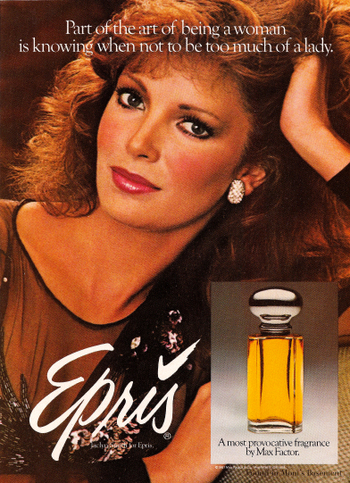
If I'd been looking for a spokeswoman in the eighties, and had a sultry perfume to sell, Jaclyn Smith wouldn't have been my first (or second) choice. While not exactly strawberry shortcake, she was never really the let's get right into bed type. Had I seen the Jaclyn-centric ad for Epris before smelling this 1981 Max Factor fragrance, I doubt my curiosity would have been triggered. Fortunately, I found a mini at some antique store last summer, traveling cross country with my mom (I don't advise this, by the way, unless you can keep your travel time down to under five hours or you're going convoy style in separate cars).
Until a week ago, I enjoyed this mini periodically but had no idea what it was, and much as I liked it, I didn't really investigate. I don't think I even checked the bottom of the bottle, where the label indicates the name. I assumed it was some Youth Dew era oriental, a one off that didn't make a wave (though it clearly should have) and barely made a dent in the mass market culture of suburban perfume lovers. At some point I even thought it might actually have been decanted from a larger, more recognizable fragrance by another traveller who, like me, needed some back up on the road. Who knew Epris was listed on Fragrantica all this time, or that I could have very easily looked into it before now?
Fragrantica lists Epris as a chypre floral. My immediate thought, reading this, was that if Epris is a chypre floral, Bandit is a fruitchouli in a faceted pink bottle. Epris doesn't even smell like a floriental to me. It's straight up balsamic oriental, with the usual suspects hiking up their skirts: patchouli, spices (clove, clove, and clove) and a generous scraping of civet and castoreum. It has a leathery feel instantly, rather than drying down to one, and while there are florals in the mix, as in Youth Dew, they've obviously been told to sit down and shut up. This fragrance wants to get horizontal, and it wants to get horizontal now. After gymnastic somersaults through spiced amber and barnyard, it gets a little powdery in the late dry down, as if to say, "Yes, that's my bosom you're smelling."
"Maybe your mother never told you," begins the television ad, "there's more to being a woman than minding your manners." You might easily assume, hearing Jaclyn Smith say this, that she's just sucked on helium. Maybe it's the quality of the recording in the version I watched. Either way, as with the designation "chypre floral", there's a real disconnect between the way the fragrance is made to sound (girly) and the way it actually smells (far end of post pubescent: pun intended). "Being a woman means sometimes taking the first step first," Jaclyn continues, after introducing herself in a sequined, mostly sheer black dress reclining on a plump leather sofa. Again, I would say leap, not step, because Epris is clearly an attack mode type fragrance, with a physical vocabulary ranging from pounce to pulverize.
Epris, says Jaclyn, is a fragrance that understands this "first step first" thing. "Epris is a little unsettling; a little disturbing. Epris is a most provocative fragrance. If mama never told you, I'll tell you: Part of the art of being a woman is knowing when not to be too much of a lady."
Whatever the tone of her voice, at least the dialogue speaks truthfully about the perfume. While the initial impression of Epris is along the lines of Youth Dew, it soon takes a slight but hard left turn toward Tabu, putting itself in park somewhere in between. Even in an era characterized by bold, forceful constructions, Epris was something of an oddball, looking back lustfully not just to Youth Dew (1953) and Tabu (1932) but to one of my all time favorites, Bal a Versailles (1962). It dives straight down to patchouli and animalics without bothering to ask you if you mind. There's that kind of confidence in it. It's on the prowl and thanks you very much for letting it out of the bottle to get the ball rolling, but no time for niceties. It don't mind if it do.
There's a taste for this kind of thing, and not everyone's salivating over it. I'm grateful, because it's scarce online, unless you want to stock up on minis until you have something approximating full bottle. I'm impressed with everything about Epris - the fact that Max Factor produced it, its tenacity, its husky attitude, its uniqueness among its eighties peers as an old school, unapologetic oriental. It's been a long time since I smelled something this good, and I was happy to find a seller online who was offering two one ounce bottles. How much do I like Epris? Better than my favorite Serge Lutens fragrance (a tie between Cedre and Arabie, in case you're wondering). Once again, I'm reminded that some of the most satisfying fragrances have been sold at the drugstore, for a steal, and they didn't even have oud in them.
Labels:
amber oriental,
civet,
clove,
Estee Lauder Youth Dew,
Max Factor Epris,
Oriental,
Patchouli,
Tabu
Friday, March 15, 2013
Had Some Work Done: Halston
Even when I was a kid and I knew nothing more about perfume than the fact that I liked it, I could see a through line from Halston, which came out in 1975, to Lauren, which came out three years later. The name Bernard Chant meant nothing to me, but the perfumer's signature was all over both. They shared a pillowy, woody warmth I now recognize as one of Chant's trademarks, a quality that carries over into Aromatics Elixir, Devin, Aramis, Aramis 900, Alliage, Cinnabar, and even his sparkling (maybe blinding) white Estee. The advertised personas of Lauren and Halston couldn't have been more far removed from each other - Halston had the decadent whisper of Studio 54 carnality; Lauren looked forward to the buttoned down reserve of the eighties - but every girl and woman I knew seemed to wear both, and their heady effects, unique among chypres, whatever their diverging promoted fantasies, seemed interchangeable to me.
Ask almost anyone who wore them or smelled them then what they smell like now and they'll invariably tell you Halston and Lauren have been butchered beyond recognition by cost-cutting reformulations. They'll say neither is worth bothering with. I can't argue a case in favor of present day Lauren, which definitely smells not only gutted but entirely rethought to me, but I part ways with popular opinion when it comes to Halston.
For a long time, I agreed, if mainly on principle, and railed at the perfume powers that be, though I took great pleasure from any version of Halston I got my hands on. The ten to twenty dollar iteration available in drugstores over the last ten years or so seemed very much like what I remembered from the mid seventies, if sharper and brighter. The husky voice Halston once hummed in seemed to have become a little shrill, the woody warmth a little cooler, but all the basic parts still seemed present, if spinning in slightly different directions.
This week, I ordered a vintage bottle from Ebay, a collectible edition with silver in place of the iconic plastic bottle parts. Spraying it on, I was surprised how little has changed, compared to what I've been led to believe. I won't argue Halston hasn't changed - at all - but I will argue that it's changed a lot less than people say. I would also argue that the changes in the formula have less to do with cost cutting, and more to do with regulations, which isn't to say cost of production hasn't been an issue in the changing face of Halston; it's just to say no more than in most fragrances.
For the most part, I'm surprised at the apparent pains taken to preserve the spirit of the original perfume. Plenty of people raised their voices at the prospect of alterations to the cherished classics at Guerlain, but who was going to make a fuss over the long-forgotten, drastically demoted Halston brand? Clearly, no one had to bother much trying to keep the thing intact. The fact that anyone did seems pretty commendable to me.
The biggest difference - and I realize that, to some, it's all the difference in the world - is the absence now of natural musks in Halston. Again, can't argue here that those musks don't make a difference. You spray on old Halston and those musks give it something special, something deep and resonant. But, risking heresy, I have to say I've never found myself pining much for those old natural musks. I appreciate their presence in vintage perfumes. I discern the difference. But to me those musks, however much they flesh out their host perfumes, have the adverse effect of poorer longevity on my skin. They're so "natural" that they become a sort of second skin, and after about thirty minutes they disappear. I tend to like more presence in a perfume. I don't mind it smelling perfumey, if perfumey means more "there". My lifestyle doesn't find me "sweating it out" on the dance floor these days, and certainly old Halston must have reactivated once it hit the mesmeric glitter ball reflections bobbing around at discotheques like Studio 54.
Other obvious, inevitable differences would be the subtraction of the better half of the original formula's oakmoss, now restricted down to a bare minimum, and, I'm guessing, higher grade sandalwood. You can't fault Halston's new owners for downgrading when it comes to sandalwood, when even high end lines are doing the same, with similar, sometimes even less thoughtful, results. That said, I admit there has been, in all the various redesigns of Halston, a pronounced dullness, a crudeness missing from Bernard Chant's original construction. Until now.
I love vintage Halston, but I prefer the version I got yesterday from the drugstore, which seems to be, judging by the label on back, the most recent formula. After a few sharp minutes, it smells remarkably similar to the collectible edition - so much so that I'll take the much more affordable reformulation over the cherished vintage. Oddly, this latest iteration is closer than ever to the fragrance my sister and all her friends seemed to be wearing way back when. It has the added bonus of enhanced projection. All that woody splendor feels amplified and sort of sings off the skin, radiating in peachy herbal waves from the body. It doesn't need heat to liven it up like a refreshening late night bump of coke. For the first time, vintage or more recent, I can discern Halston's constituent parts - balanced lines of marigold, rose, cedar, pathcouli, vetiver, ylang, and jasmine. It lasts more decently than most of the niche fragrances I own, and feels a lot more satisfying overall. Nothing smells like Halston these days - with the exception of this reformulation. And frankly, no "new chypre" smells more like a chypre is meant to smell than this cheap little denigrated number. I'd wear this stuff over any number of contemporary so called chypres any day, and consider it far more valuable in many ways than their drastically opposed price tags would suggest.
If the throwaway, disrespected drugstore Halston can make chypre smell this good in the present tense, it begs the question: why are the larger, more respectable corporations charging so much to make it smell so impeccably foul?
(How to tell which version you're dealing with: The version I tend to like the least has the name Halston printed on the glass of the bottle. The ingredients listed on the back of this version's box go something like, "alcohol, fragrance, water" and a few blues, yellows and reds, each followed by a distinguishing number. This version is manufactured by EA Fragrances Co., but slightly earlier versions (early middle period, let's say) list FFI Fragrance International. The slightly earlier, FFi version is even less preferable to me than the allegedly wretched EA version. Go figure. Earliest versions of the fragrance list Halston as the manufacturer. These versions will tend to have all natural musks and oakmoss ratios intact. They smell the richest, the most plush. The most recent version returns to the blank bottle, sans imprint of the brand name, and everything but the kitchen sink is listed on the back of the box. Middle period boxes have, on the inside, a pattern of interlocked H's. The most recent formula, and late middle formula, has this as well, but the cardboard sleeve containing the perfume, nestled inside the box, is plain, whereas during the early middle period, the cardboard sleeve bore the pattern as well. Of the middle period, I probably prefer late FFI version, which smells more like a chypre than its younger EA sister. If you go hunting on Ebay, your best bet is to stick with bottles still in their boxes, so that you can communicate with the seller about these various distinguishing characteristics. But I recommend the most recent version as well, and it's available at most drugstores. Got all that?)
Labels:
Bernard Chant,
Chypre,
Halston,
Marigold
Tuesday, March 5, 2013
Amber Alert: Ambre Dore by Maitre Parfumeur et Gantier
A few years ago, when I discovered that Bonwit Teller carried the Maitre Parfumeur et Gantier line, I bought a few of my favorites over the phone. At that point, it was hard to find some of the older MPG fragrances - like Eau des Iles, Parfum D'Habit, Camelia Chinois, and Ambre Precieux. Even the stores that did carry the line didn't seem to include such rarities in their inventory, and one day, talking to the sales associate, I discovered there was one so rare I'd never even heard of it. Soir d'Orient had been reviewed three times on Makeupalley.com and averaged a rating of four and a half. It was described at the time (pre oud craze) as a leather amber with smoked vanillic facets. And Bonwit Teller hadn't carried any in quite some time.
Fast forward to 2012, when MPG announced the release of a new fragrance called Ambre Dore. More than a few comments online remarked at the similarity of notes between Dore and D'Orient. Were they the same fragrance? The notes I could find for Soir d'Orient included amber, oud, and leather. The notes for Dore: essence of oud, ambergris, saffron, styrax resin, coriander, myrrh, and vetiver. Fragrantica eventually cleared the air with its listing for Dore. According to them, it was in fact a reissue of that 2006 rarity formerly known as Soir D'Orient. The craze for oud made this once special issue fragrance, exclusive to the Eastern market, now marketable to the rest of us.
My hopes were pretty high for Dore, as Soir D'Orient, its former incarnation, represented that now practically extinct thing in perfumery - something I wanted but couldn't get my hands on. And while almost no fragrance I can think of could possibly fulfill such built up expectations, Dore makes an admirable go of it.
The few reviews I've read commend Ambre Dore for its robust, animalic opening. If you consider oud animalic, they might be right. For me, it's a smooth, ambery melange which smells a little like leather but more like what we've all now pretty much agreed is "oud". Whether this is "oud essence", as MPG says, or good old fashioned cypriol I can't tell you, but it's pretty fantastic either way. I don't know what I would have made of this opening four or five years ago, before oud became so ubiquitous in niche perfumery that it might as well be fig or iris. I might have regarded Soir d'Orient as "slightly medicinal", which is how we were all describing oud back when it made its first, feeble bid for our attention. I wouldn't have helped support its journey West, I suspect.
By the time I finally caved and bought a bottle of Ambre Dore, I'd been searching for the near perfect amber for several months. Ambre Dore comes nearer to that near than anything else I've gotten my hands on. After its wonderfully rich opening, it settles down into a slight variation on the wonderful Ambre Precieux, with touches of resins and vanilla, a fairly old fashioned take on the classic amber fragrance, which is the kind of thing I like. Ambre Russe has this quality, to some degree, though it perks things up with apple. Lutens' Ambre Sultan, despite all the herbs, is pretty old fashioned. Still, Sultan is too much of a skin scent for me; Russe is wonderful in almost every way, and I can't tell you in just which way it isn't quite as wonderful as I'd like it to be. I like some amount of oomph in an amber, and some of my favorites, much as I love them, get a little too powdery a little too quickly. When they don't get powdery, they start to smell less like amber. Even once it mellows considerably, an hour or so in, Ambre Dore has that kind of weird, edgy quality it showed in the opening. It dries down as satisfyingly as it starts out, and for me it's amber bliss.
Even more than the amber, I love the oud, which has surprised me. Oud is so over-exploited now that I cringe at the sound of the word. Everyone has a wonderful new oud, which smells no more or less wonderful than the last. Oud seems to have finally given niche perfumery the excuse it was apparently looking for to boost its prices laughably high. It was a real dilemma: how do you package perfume in the same old bottle but charge more? Oud answered the question, however insipidly. You import "costly" oud "essences" from the East. We are now in the Baroque Oud period, where niche lines release their second, third, and even fourth oud fragrances. Their last oud smelled like every other, but they convince someone (if not me) that they have something new to say with the material, which is invariably synthetically composed, no matter the claims of faraway and hard to reach origins. Nothing is hard to reach anymore, but oud convinces us that state of covet versus lack still thrives, right under our noses.
Ambre Dore is an oud fragrance which doesn't scream oud. No mistake, you smell the oud in it, but it's incorporated as a supporting player - perhaps because Soir d'Orient came out at a time when oud wasn't something to write, let alone leave, home about. Ambre Dore used oud with the kind of subtlety that no modern oud release can really afford to, and wins me over for that. It's a pretty exceptional scent.
If anyone else has favorite ambers I'd love to know.
Thursday, February 14, 2013
Naomi Goodsir: Cuir Velours
When I first smelled Cuir Velours and Bois d'Ascese, the debut duo of fragrances by Julien Rasquinet for Naomi Goodsir, Bois d'Ascese was the clear front runner. It seemed a no brainer (wood, smoke, fifty shades of burnt). Cuir Velours was lovely enough, but I seemed to have forgotten it the next day. When I sprayed on some Bois d'Ascese, and wore it out of Scent Bar in LA, it faded a lot more quickly than I can tolerate in a smoke fragrance, and I sort of forgot the line altogether.
Until last month, when I was back in LA, frequenting Scent Bar a lot more than I have any business to. I'd long since decided that Bois was a tamer, less interesting sibling to Essence of John Galliano, the (now discontinued?) room spray by Diptyque. Galliano is my go-to woodsmoke scent. I spray it on clothes; typically, on a scarf, in the winter. It reminds me of homecoming bonfires in high school, where no matter where you stood the smoke made a bee line for you. Galliano is a holy grail for me and it hasn't been improved upon yet. I have something like six ounces and doubt I'll run out any time soon. I see no reason to cheat on it.
Somehow, now that Bois had receded from view, I was able to smell Cuir Velours more clearly, and after several trips to Scent Bar I was hooked. I kept going back to it, re evaluating. It was my final purchase, and once again I'm struck by how a good perfume can take a while to permeate your attention. It's as if you have to catch up with it, or get it somewhere on its own, before you can truly appreciate it. This is one of the reasons I don't write so much about new releases. Almost every fragrance seems route to me upon first sniff. It takes a long time, living with one, to see it on its own terms, a long time to recognize its distinct appeal.
Part of my problem with Cuir Velours at first (it seems like such a non problem now) was the fact that it didn't really smell like a leather to me at all, neither soft nor hard. I couldn't really see the connection. Now I smell it and wonder what the hell I was thinking. These are all good signs in a fragrance for me - that initial disappointment, followed by a shift of perception and a percussive revelation. Cuir Velours is a different kind of leather, and I think I must have mistaken it for all those wan suede things that have pepper sprayed the market over the last several years, scents which seem to be apologizing for leather's offenses even while capitalizing on its mystique.
Velours bears some relation to Daim Blond, the Serge Lutens suede that, for a change, gets it right, adding a startling peachy note to shake up a tired format. Cuir Velours sits somewhere between leather and suede, and while it feels more refined than your average leather (usually a turn off for me), it's saved, or maybe energized, by the judicious use of immortelle. Though I know it's a take no prisoners note within a composition, I've always felt that you can never be too liberal with immortelle. Too much has never been quite enough for me, which makes my appreciation of its subtle application in Cuir Velours at the very least...confusing. Like Daim Blond's radiant peach note, immortelle adds something beyond articulation and infinitely appealing to Cuir Velours basic structure.
Cuir Velours (aside from immortelle, notes listed are rum, labdanum, and incense) has a reputation already for being a variant of Skin Scent. I don't get that. On me, it radiates off the skin for hours, quietly but persistently. It smells, now, of leather, but its own peculiar version of leather. Like most good fragrances, Cuir Velours caused a recalibration in my thinking about what a leather is or can be. It's rich and, truly, velvety, with just the right touch of boozy - clean but compelling.
My experience with it makes me wonder how often this happens with other people - the vague interest which turns to strong, committed affection.
Sunday, December 23, 2012
Dear Year: Reflecting on 2012
There weren't many surprises for me this year, but plenty of memorable moments. In May, for instance, after a grueling film shoot, I traveled to Portland to visit The Perfume House, my favorite perfume haunt. It was a good time to go back, as it had been a few years, and I was in a place I needed to reconnect with that original excitement perfume held for me. I discovered perfume at The Perfume House, really. I learned about Lutens there, L'Artisan, Nicolai, and scores of other fragrance options I'd never known about or even suspected.
I spent several days in Portland, which meant several days inside The Perfume House. There's a single window in the place but it's highly placed and small, and for the most part you feel you've stepped back in time, or to some pocket of time, past or present, that exists independently from the outside world. The staff feel like old friends by now, and even after all this time, having scoured the place from top to bottom, there are new discoveries, things on a bottom shelf I hadn't noticed before, or hadn't known to look for, like an old bottle of La Nuit edt, some early Rosines, and Basile, my favorite, and cheapest, discovery of the year. Basile is instant happiness for me: somewhere between Opium and L'Arte de Gucci, a subtly spiced green rose no one talks about and no one's put an exorbitantly priced sales tag on.
The weather during my trip to Portland was unusually sunny and combined with the experiences inside The Perfume House it buoyed my mood. One day, standing in the shop, I met a man who cultivates hybrid peonies nearby. He waits several years for results, and had just stopped in to show the latest fruits of his labor, two dodge ball sized peonies, one butter yellow, one blush pink. He carried them around as he spoke to the staff, talking about his process. It struck me that it takes him as long to grow a peony as it takes a perfumer to create a perfume.
The staff of the store keeps all the testers of its discontinued fragrances, so I was able to smell a few old Weil scents, Secret de Venus and Bambou. Both were beyond words, and reminded me that the past of perfumery is just as essential as the present, however hard to track down - and that the store which values this past becomes a real asset to the perfume lover.
There were only a few scents that pleased me as much as Basile. At Lucksyscent for the launch of Tableau de Parfums' Loretta with Andy Tauer, I picked up a bottle of Santa Maria Novella's Patchouli, expecting not much. I was just standing there, and it was too. So I smelled it. Turns out it's my favorite patchouli, richly herbal with chocolatey undertones, and the surprise demonstrated for me that there are still discoveries to be made, right under my nose, where I least expect them, if only I keep my mind open. It's harder and harder to do that but maybe more necessary now than several years ago, when the discoveries were so numerable I didn't have to think much about how to wait patiently for them.
The buzz this year circled furiously around fragrances that ultimately disappointed me in a big way. I shouldn't be shocked any more by the disparity between what I've heard and what I smell. I should know better at this point. Still, I was taken aback by just how boring so many of these scents were. The Ramon Monegal line was nice in places - Mon Patchouli, Kiss My Name - but emblematic as well of the high price one's asked to pay for small pleasures in the current perfume marketplace. Kurkdjian's Amyris duo was instructive, not just the scents themselves but the way they were talked about. Bloggers praised them as mainstream done well, which to me, once I smelled them, seemed like a not so coded way of saying even mediocre is exceptional when you lower your expectations sufficiently, spoken the way you do when you're in bed with the subject of your appraisal.
That told me a lot about perfume reviewing now as well. I read all the perfume blogs daily when I first started smelling, and up to the last year I continued to read even those whose prose seemed the most steeply canted toward ass-kiss. I've stopped reading all but a few now, having realized finally that for too many bloggers it's more important to know the creator of Volutes well enough to chat her up at a party than to report on the fragrance with any kind of useful honesty.
The other side of this is the tendency toward "hostility first, sober assessment later" for all things fragrant, a trend I saw more and more of on the fragrance boards and consumer review sites this year. I believe the two go hand in hand. Perfume lovers know in their guts that, however well written some of these blog narratives are, they're chronically disingenuous and often self-serving, a pretty girl insisting everyone affirm her prettiness, however ugly her behavior. More and more, bloggers seem to have crawled into bed with the makers of perfume, not just perfumers but the corporations behind them. It's only natural that the consumer, sensing this, would react defensively, distrusting everything sight unseen.
I think something will have to change, and fortunately, everything eventually does. I view this type of blogging, however current, as already paleolithic, and I look forward somewhat hopefully, though hope is against my nature, to something different, where these voices will be seen for what they are and others who haven't yet been corrupted by the betrayal of their own weak egos will start talking a little more loudly.
This shift in perspective characterized the year for me. I lost a friend in October, and the process of grief involved re-evaluation and re-prioritizing. What matters started to matter more to me after that, but I'd been moving that way for months. We're living in a highly accelerated moment, where a lot of information and many options are thrown at us on a daily, even hourly basis. We're encouraged to feel I think that we must work very hard to vie for attention, which means being heard. At the same time, we're led to believe that in this state of affairs things can still feel and be special. Who cares if by shouting I can be heard, if what the listener takes away is a lot of shouting.
By October, I knew several things: I knew that those two modes of consciousness work together destructively and are in fact actually contradictory, and I knew that I needed to step away a little so that I could somehow get back in touch with what does matter in life. At this point I need to believe, with confidence, that some things do matter. If every new perfume release does, then really nothing can. I want a little more intention in my life - in the things I value and connect with. And I want to believe a connection can transcend the next several minutes or days the way we like to say perfume can. Like my friend, a profound perfume is unique in its ability to reach you and bond with you. The most impressive thing about it shouldn't be how much money it has or how many friends in high places. I need to learn I think that the exceptional peony comes after a patient wait, and that the waiting is as important and valuable as the eventual appearance of the flower.
I hope everyone's had a good year, and is out there making personally meaningful discoveries, and perseveres in the belief that ultimately the best barometer is your own mind and heart.
Subscribe to:
Posts (Atom)