Showing posts with label animalic. Show all posts

Friday, February 24, 2012

Honey, I Stunk the Kids: Byredo M/Mink


Even among the fragrances I love, there are those I put on once in a while and like a little less than I usually do, but Byredo M/Mink never fails to to satisfy. It took me about six months to a year after I first heard about it to get my hands on some, and I expected to be disappointed, or at least only mildly enthused. I wasn't prepared to admire it as much as I do, but the reaction was instantaneously favorable. M/Mink pushes all the right buttons for me.

A wonderfully strange mix of honey, incense, and aldehydes, M/Mink is one of those fragrances people on the perfume forums warn you to give time to mellow out on your skin. They complain about the top notes and advise patience, promising a more bearable result as your reward. I've never really understood this line of thought, because generally when I like a fragrance two hours later I liked it two hours before. M/Mink, especially, smells pretty linear to me. And in fact that first spritz is maybe the best part of all, if only because it never fails to give me a little shock of pleasure.

Honey I guess is a love/hate element in perfume. The most legendary use that comes to mind, or at least the most polarizing, is in Serge Lutens' now discontinued Miel de Bois, where the stuff is so overloaded you feel you've wandered into a neglected public restroom. More recently, honey was used more subtly in Aromatics Elixir Perfumer's Reserve, its acrid bitterness made plush by jasmine, rose, and orange blossom. Honey, or something like it, was a staple in a lot of the 80s fragrances I love - Ted Lapidus Creation, YSL Kouros, Rumba, and Guerlain Jardins de Bagatelle come to mind, though not all of them list it - often mixed with so much tuberose that where one begins and the other ends is anyone's guess.

M/Mink has an entirely different approach. Rather than emphasize honey's drippy, dense qualities, it shoots it through with aldehydes. Givaudin describes Adoxal, the aldehyde listed in M/Mink's published pyramid, as "fresh, marine, powerful, floral," adding that it blends well with floral notes but, more to the point here, "can also be seen as having a typical 'fresh linen' odour which makes it very useful for detergent perfumes."

I would call M/Mink minimalistic. Others have called it unfinished. But it's only unfinished to me in the way an Agnes Martin painting would be. That fresh linen quality, contrasted with honey and frankincense, registers alternately as animalic and inky, justifying the name. There's something like hot steam and iron in M/Mink. It's both balsamic and breezy, unwashed and clean. Only a minimalistic composition, a bold juxtaposition, could achieve such a strange but harmonious contrast, by turns stark and full bodied. An underlying waxiness is maybe the best part to me, because it somehow seems incompatible with the overall blend, and yet right at home.

It's harder and harder to achieve such startling, or refreshing, results in modern perfumery. Most perfumes seem trapped in the losing battle to recreate the big picture past of classic perfumery with increasingly thinned out materials meant to mimic the opulence of the things they replace. M/Mink does an about face, showing I think that the road ahead might be less, artfully judged, rather than more, artlessly combined.

(Pictured above: an untitled painting by Agnes Martin, circa 1997)

Sunday, February 6, 2011

Coze: Parfumerie Generale


It surprised me to discover I've never written a review or even really anything at length about a Parfumerie Generale fragrance, especially given the fact I like as many of them as much as I do. While I wouldn't say I like Coze the best, I do think it epitomizes perfumer Pierre Guillaume's style: sweet and woody, an earthier recombination of elements you find in the work of Christopher Sheldrake for Serge Lutens. Sheldrake sometimes errs on the side of syrupy excess. Coze works these balances out perfectly, calibrating the sweetness so that it feels less like something off a pastry shelf, more like something you'd find some tree trunk leaking out in a moss-laden forest.

Friday, January 21, 2011

Skank You Very Much: Francis Kurkdjian's Absolue Pour le Soir

I wasn't a major fan of the earliest offerings from Maison Kurkdjian. I liked them. I didn't love them with a 175 dollar passion. I didn't love them as much as the big-bosomed SA at Saks, who seemed to have taken some manager's admonition to sell "racks" a little too literally. Even her effervescent, busty personality couldn't persuade me to shell out for the scented bubbles Kurkdjian had on display. Like many people, I think bubbles are a nifty idea. I've blown my share of them. Some of the novelty wears off when you price them as luxury items.

I've been waiting for a Kurkdjian I can really get behind. I knew it would show up eventually. Absolue Pour le Soir is one of those fragrances I'm a total sucker for.

Tuesday, January 11, 2011

Paloma Picasso Mon Parfum


Watching youtube videos last week really stumped me.

There are what seem like thousands of tween girls reviewing their favorite perfumes online, if not their entire perfume collections. I'm in love with all of them--and addicted to watching them. It made me think about recent comments made by more seasoned bloggers alluding to the idea that there are way too many people blogging about perfume. It's just too noisy, they seem to be saying. It's just too messy. Obviously, these bloggers haven't sullied themselves by visiting youtube much in recent years. Bloggers don't stand a chance in that thicket.

It's amazing to see how many people out there love perfume, and want to share it with you. I appreciate what they do--how earnestly they approach the subject. Some of these girls have made me a fan. They bring you right into their rooms and break it all down for you--whether it's Britney Spears Curious or Donna Karan Signature. Far from making me feel threatened, their enthusiasm and ubiquity have paralyzed me with admiration. You don't hear much talk from them about the perfumers behind the perfumes they love. You don't hear much about their pyramids, provenance, the fragrance industry, sales figures, or ad campaigns. Typically, these aren't technically reviews. On a basic level, they're purely personal--this is what I like and why--so personal that you realize nothing else ultimately counts for much. These girls state the case so effortlessly, some of them, with so little guile or fuss, and so much personality, and here I am, plugging away at this post about...

Oh yes: Paloma Picasso.

Tuesday, November 16, 2010

Underrated: 3 More by Etat Libre D'Orange

It really intrigued me, the past six months to a year, watching what people had to say about the last several releases from Etat Libre D'Orange. It intrigued me, when I didn't let it get to me. Like This and Fat Electrician were pleasant enough, to me, but nothing particularly special. Like This (after Tilda Swinton) was a creamy ginger thing; Electrician a now-standard issue grungy vetiver. What was all the fuss? With Sex Pistols and Josephine Baker, both done in partnership with the Sephora Chain, it's beginning to look as if Like This and Fat Electrician weren't merely a temporary downward trend, as I'd earlier hoped, but the shape of things to come at Etat.

I liked what everyone seemed to hate about the brand: how silly they were; how irreverent. They were restless in a pretty refreshing way. What many saw as shock value and empty provocation seemed just as arguably a thoroughly thought-out exercise in dada to me. None of this would have mattered, or been anything other than annoying, had the fragrances themselves not been so interesting and, for the most part, durable.

I loved how offended everyone got by the Etat packaging. I kept thinking, Seriously? It was so fun--such a tease. The ideas at play in the fragrances were so quick-witted. And why not? What makes it more acceptable to put a skanky, animalic fragrance behind a facade of pseudo-respectability? More respectable perfumers could sell any amount of crap in a beautiful bottle, fronted by some boring blonde or brunette, her pose and context (usually prone, typically sex-related) a male's deranged idea of a woman's inner fantasy life, and while people seemed to grumble periodically at the bombast of it all, they ate it up. They still do.

Etat poked fun at all of that with a cartoon phallus and for this they were regarded as pandering to the lowest common denominator, the basest of consumer instincts. The casual or hostile disdain people directed towards the fragrances themselves still astonishes me, given the relative lack of discernment with which most fragrance campaigns are received. Why is it that we praise Etat when they become most like other things, while failing to scrutinize the continued smoke and mirrors of reformulation going on over at stately Serge Lutens?

With Like This, Etat put on its church finery. Suddenly, people who'd slammed them for their so-called pretensions and silliness were praising the company for getting serious, for putting out a fragrance which had stopped all the clowning around. Now this--Like THIS, finally, was a scent worthy of critical discussion. Really, all those theatrics: how tedious that all was. Here was something . It was as if Britney Spears was over all the head shaving, limo-infesting antics. She'd gone back to extensions and gotten all that out of her system. Hurray. Back to mediocre pop. The baby girl voice was perfectly acceptable, as long as she wasn't singing from behind the rail of a crib.

Were we all talking about the same scent? Like This was so pedestrian. I could smell Etat in it, but only just. It seemed to me that people were overcompensating. Maybe because Like This was more approachable, and Swinton herself characterized the company in quite a different vein than, say, Rossy De Palma had a year or two earlier, people seemed to feel the need to use Like This as an example of what had been wrong with the line all along, and why they could now bring themselves to endorse it. Swinton was, like her namesake fragrance, weird as in avant garde. De Palma was weird as in self-conscious parody, willfully bizarre. The one was class; the other camp. These are just my own hypotheses, because, to me, Swinton seemed as likely and as consistent a choice as De Palma. It's how people regard and appraise them which differs.

I own most of the earlier Etat fragrances, and I still marvel at how fun and satisfying they are. I've written about some of them. Others I intended to get to, eventually. Then I got distracted, and lost interest in the line. I resented the turn the conversation about the brand had taken. I still hope this is temporary. Like every line, Etat has had misfires. It tries new things. Regardless, today I wanted to revisit, in print, several of the Etat scents I've never talked about.

Charogne

You would think this stuff were Secretions Magnifiques, the way people go on about it. "Very disturbing, nauseating, even anger-inducing," began one of the customer reviews at Luckyscent.com, as if she'd been forcibly subjected to something without warning. "I haven't smelled anything this vile in a long time," wrote another.

There's oddness aplenty in Charogne--but it stops just short of truly unsettling, and miles away from disgusting. Lily, vanilla, jasmine, incense, and ylang ylang don't often end up in the same pyramid, to be fair, but surely this is a more unusual and possibly a more intelligent use of ginger than Like This.

Charogne goes on with a slightly off smell. It takes the fragrance right to the edge of what you tell yourself a fragrance should be, but this makes it sound much weirder than it is. Ultimately, Charogne is a great floral amber with a touch of vanilla, and it lasts forever. It speaks to classic perfumery, playing around with the macabre in ways which are infinitely wearable.

Delicious Closet Queen

I liked how self-reflexive Closet Queen was when I first smelled it. It plays around not just with what a typical mall masculine should be but with Etat's own body of work. Closet is a fascinating perversion of an earlier Etat fragrance, Putain des Palaces. Both were created by Nathalie Feisthauer; two of only three she's done for Etat (the other, also good, is Nombril Immense).

Closet Queen and Putain are distinctly different, and yet they speak very strongly to each other. Putain is something of a lipstick violet cum leather, no pun intended. It puts a man in the room with the hooker from the fragrance's title. Closet Queen equalizes the same basic arrangement, conflating genders. It's that same man, after he's locked himself in the bathroom with his escort's cosmetics.

Some days, In some ways, Queen smells like half the masculines at Macy's. That's a big part of it's effect. There's a forcible tension at play between traditional ideas about masculines and feminines, an astringent cedar romping around with a creamy, voluptuous violet and rose. Typically, just when I decide I should be bored with it, the fragrance piques my interest again.

Vierges Et Toreros

To me, one of the weirder Etat fragrances; weirder, I think, than Secretions Magnifiques. Let's face it, the weirdest thing about Secretions is that anyone might consider it a fragrance in the first place, a joke for which some refuse to forgive it, let alone the entire line. Vierges has a tuberose note in it and perhaps one day I will smell it. I'm not sure what exactly I smell, which strengthens my attraction to the stuff.

The notes are: bergamot, pepper, cardamom, nutmeg, ylang ylang, leather, costus, patchouli, vetiver, and the alleged tuberose. Again, I smell none of these in particular. But oh what a combination. Vierges is one of the longer lasting Etat fragrances on my skin. Sprayed liberally, I get a stronger impression of florals. For me, it's a far more interesting, certainly more durable, leather than Chanel's equally strange but vastly more short-lived Cuir de Russie. It's a strange, space age take on a floral leather, and every time I smell it I get a little frisson of happiness. Monk, by Michael Storer, has a similar quality to it--an animalic vibe with an underlying whiff of musk and incense. I never want to be without either.

Saturday, November 13, 2010

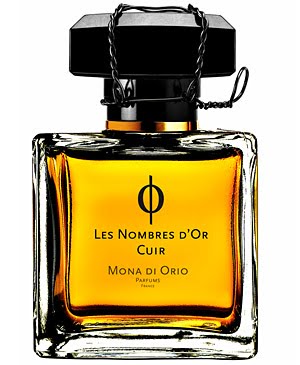
Mona Di Orio: Cuir


I can't really find an antecedent in Mona di Orio's work for Cuir, which is both a good thing and a bad thing. While several di Orio fragrances have been, like Cuir, pretty bold, they were also a lot skankier, creating a series of expectations and biases around the perfumer's work. Nuit Noire dries down to what Orio retailer Luckyscent refers to on its website as "a barnyard-y animalic dirtiness" which wasn't everyone's roll in the hay. Even Carnation and Oiro have more than a whiff of the underbelly to them. Cuir is no less an affront in ways I find appealing, but in an entirely different direction.

I like Nuit Noire very much, and when I read about Cuir, part of the perfumer's Les Nombres d'Or line, I assumed it would be an elaboration of that somewhat notorious fragrance. Given Orio's treatment of the indolic and the overripe, I expected Cuir would be a sort of apogee for her sensibility, a sublimely ferocious, unwashed leather. Cuir isn't unwashed, and it isn't particularly feral. It doesn't seem in keeping with anything else Orio has done--had it come in packaging other than her trademark champagne bottle muselet, I would never have attributed it to her--but it's a fantastically remorseless fragrance, and it bums me out that her reputation for a special brand of skank and an unfairly malicious and dismissive rap from critic Luca Turin might keep people from giving it the time of day.

Cuir doesn't particularly smell much like a leather to me, either; no more than Parfum D'Empire's Cuir Ottoman does, I guess. Luckyscent calls it carnal, and I can understand why. A few months back, I reviewed Incense by Norma Kamali, another arguably carnal scent, if by carnal you mean in part unapologetically robust. Cuir initially reminded me of Incense--the stuff is unmistakably strong--though for all its assertiveness, there's a weirdly unique delicacy to Cuir. When it first goes on, you smell the cardamom and the cade, something close to smoldering spices. The cade isn't so brutal that you can't make out the cardamom, so there's a balance going on there, but a tricky one, and Cuir very nearly tips the scale into overkill. Incense doesn't have that kind of tension. It has a glorious bombast which Cuir shies away from, if only just. It's full throttle, out the gate, and straight to the grave.

Both fragrances are smoky to the extreme. Incense is much more resinous, whereas Cuir smells more like something you'd walk through than on. Supposedly there is opoponax in the mix. Who can smell it, under all that smoke? More immediately apparent is the castoreum, which gives the affair something approaching wet animal hide, rode hard, put up wet, now roasting on a spit. This is really the whole story to Cuir, but this simple constellation of elements is more than enough, telling a bigger, more complex story than fragrances with twice to three times the ingredients.

I love Cuir, and I know it will last me forever. It's sometimes--okay, frequently--too much for me. A little goes a long way, as they say. But what a road that is to go down, even just dipping my feet in it. I believe there's a much needed place for these fragrances, now more than ever, and far too few of them. They adjust one's barometer, demanding of you a certain kind of attention and commitment. They cleanse the palate by overloading the senses. With so many fragrances pandering to lowest common denominators, endlessly dumbing themselves down, seeking shamelessly to be all things to all people, something like Cuir is a handy reminder of the refreshment a willfully difficult scent can provide.

Sunday, July 11, 2010

Mystery of Musk: my observations on five

I suppose I should tell you what I think smells musky. Examples of pure musk for me are Kiehl’s Original Musk and Serge Lutens Musc Koublai Khan. The former seems your basic musk, neither clean nor dirty, Kiehl's is a complete reference musk in my mind, while the latter has some unclean properties. When I was a kid certain musks like Alyssa Ashley and Coty Wild Musk were all the rage so these register as smelling like basic musks to me. There are loads of musk perfumes on the market but the majority seems to fall in one of two camps, either vanilla musks (Creative Scentualizations Perfect Veil, Sonoma Scent Studio Opal) or clean musks (Serge Lutens Clair de Musc, Donna Karan Cashmere Mist).

I went to Whole Foods Market to sniff a few musk oils just to double check my thoughts on what plain old musk smells like. Egyptian musk and Oriental musk from Kuumba Made smell like your garden variety musk to me, with the Egyptian Musk being most animalic (aka bum sweat and/or armpit). I also gave Sonoma Scent Studio’s Egyptian Musk a sniff to find it’s a really nice take on musk. SSS isn’t an all natural/botanical perfumer; she uses synthetics, which, aside from her brilliant blending skills is another reason why her perfumes last so amazingly well. I also re-tried Annick Goutal Musc Nomade and this, once again, ended in frustration. I cannot smell Musc Nomade. I am utterly anosmic to it. There may as well be a few drops of water on my arm. So, with this leeetle bit of background information I’ll delve into a handful of the perfumes making up this project (in no particular order whatsoever):

oh, and, just another disclaimer or two (sorry, need to get this off my chest): I do feel bad for not Loving all the fragrances in this project, but I believe it’s crucial to remain honest in any perfume review, no matter how personally involved one feels. Some of the perfumers participating in this project are small indie artisans and it pains me to find a few of them lacking. It really does. But I also know this is solely my opinion and others might love what I dislike, and so it goes. I am also purposely NOT reading the reviews of other blogs participating in this project. I want to smell “blind” without influence from anyone else. So if I end up commenting similarly or to the contrary, well, so be it:

Perfume by Nature
hails from Australia and entered a fragrance called Craving for this project. Craving, to me, smells like chocolate chip pancakes with a hefty dose of maple syrup. There is a teensy musk note in the base, which, of the scents I’ve worn so far, is actually the most animalic and potentially the most interesting considering its non-animal/botanical source. The overall thrust of Craving is uber-gourmand; very sweet and not a breakfast for diabetics. The musk here is hidden and I wish it was more pronounced because I think there’s a lot of potential in this musk note.

Providence Perfume Co. entered a fragrance called Musk Nouveau. Musk Nouveau opens with a medicinal and balsamic entrance that I’ve come to associate as the trademark of Strange Invisible Perfumes. I mean this as a point of reference and compliment because I like a good number of SIP fragrances and I am not inferring that there’s any copying occurring here. The comparison is merely a reference. Musk Nouveau is quite nice, I smell some woods, some patchouli done with a light hand and a dash of coffee and pepper. I’m not getting a lot of what I perceive as musk here, but I am getting a nice fragrance.

Jane Cate, nose behind A Wing and A Prayer Perfumes in California entered a scent called Tallulah B2. Tallulah B2 is named after Tallulah Bankhead, an outrageous and witty actress from the depression era. Tallulah B2 opens up very sweet and citrusy with zero musk in sight. I felt a little panicky with this one at first, but then it mellows into a vanilla musk type of scent, in the same vein as SSS Opal or Creative Scentualizations Perfect Veil. Tallulah B2 morphs once again after about an hour when I do start to detect a lovely, albeit clean musk in its base. Once dried down I quite like this cozy little number. This is one of those perfumes which could easily be described as a cashmere sweater. It’s lightly sweet, lightly musky, with the idea of some fruit and nuts (I smell hazelnuts or toasted almonds) and it’s simply effortless.

Sharini Parfums Naturels from France entered a scent called Graines de Paradis. Graines de Paradis opens rather bright and citrusy and settles into a heart of balsamic drenched florals. The thrust of this composition seems to lend itself to being labeled a floriental with a bouquet of florals emerging more than anything musky. It does, however, have some musky and woody base notes because it registers as a floriental and not a straight floral. There is sex appeal here, folks. The longevity is good at about 3-4 hours but like most of these naturals the sillage is nonexistent.

Anya’s Garden
entered a fragrance called Kewdra and whooooaaaa mama this is the most sultry, dark scent I’ve sniffed thus far from all the entries. Kewdra is based upon the heroine, Kudra, from the novel Jitterbug Perfume by Tom Robbins. If you haven’t read Jitterbug Perfume yet, it is a must read for anyone interested in fragrance and who also likes an immensely quirky yet unforgettable good romp. In fact, just thinking of Jitterbug Perfume gives me an olfactory memory of reading it. The book conjures the smell of musk musk and more musk. It’s a musky tale if you know what I mean. Anya’s Kewdra is a dark, exotic, scent, ever so slightly sweet and floral. The fragrance itself is a dark amber color and when I first applied it to my skin I thought it would stain, like a henna tattoo. Well, it doesn’t stain, but it does give me the impression of being super saturated and dense. It turns out Kewdra isn’t overly potent, once worn it is not overpowering but it has a nice heft for a natural.

Thus far, I haven’t smelled musk as I know it. I haven’t smelled anything in the way of Kiehl’s Original Musk. But what I have smelled is so varied and interesting.

Sunday, February 28, 2010

Excessive Indulgence in Sensual Pleasures: Black Phoenix Alchemy Lab's Debauchery

After wearing it for more than a month now, I'm convinced that anyone smelling Debauchery on me wouldn't just be surprised to find out it's an oil, but shocked. I won't get into detailing what makes an oil smell like an oil. I'm not sure I could tell you. And I'm not going to argue that a perfume is preferable to a fragrance oil. I don't believe it is. I happen to like good fragrance oils, and some of my favorite Black Pheonix Alchemy Lab scents could never be mistaken as classic perfumery, a distinction which often appeals to me. They're always something different. What's so unusual about Debauchery is that it smells more like classic perfumery than most of the classic perfumes I've gotten my hands on.

The mix includes civet (synthetic), red Egyptian musk, and opium, but I find it hard to believe there isn't more in there. Black Phoenix oils tend to be pretty complex--or appear to be. They do typically go through various stages, so much so that many reviewers break their assessments down into three categories: in the bottle, wet on the skin, dry on the skin. That's another way of saying top, heart, and base, though the stages play out at different rates. I point all this out because, while it's been my experience that the BPAL oils change a lot as they wear, they aren't exactly shape-shifters. For the most part, they don't start out dog and end up cat.

Not so Debauchery. In the bottle, Debauchery is strictly your "Who farted?" one-liner. I've never smelled such a dose of civet, and I've smelled--and love--Mona di Orio's Nuit Noir, the animalic thrust of which divides people like a brick wall. Debauchery is powerful stuff at first, as if all its component parts were clenched tightly into...a fist. The moment you put it on, everything starts to relax, eventually softening into an unusually sublime wear. Debauchery smells vaguely floral, slightly animalic, musky, even a bit powdery, though by a bit I mean so faintly you'd have trouble putting your finger on why.

It smells to me like what I expect the old-timers will when I finally get my hands on them. I'm often disappointed with those. I won't name names. And it's not always due to reformulation. Debauchery delivers on their promise. I think the fragrance it comes closest to in its dry down is Paco Rabanne's discontinued La Nuit. To give you an idea of La Nuit's character, I offer the following anecdote. I once put some on a friend before we left for the evening. It was summer and we could smell the stuff radiating from her body all night. We stumbled back very late, worn out from walking and sweating and various other nocturnal activities. Not everyone thought La Nuit smelled divine. My friend was attacked by a usually placid chihuahua on our way home. She bent down to pet it after permission and encouragement from the owner. The dog lunged at her as if it had been surprised out of its slumber by a ferocious wild animal baring its fangs, and probably would have torn into her had he or she not been restrained by a leash. Nice little doggy became, in a flash, wolf in sheep's clothing. The owner was shocked silly. He'd never seen anything like it. Neither had we.

By classic, I mean French, and by French I don't just mean French perfumery but French films, French men and women, a stroll along the Seine, a sudden confrontation with the Arc de Triomph after an unexpected turn onto the Champs-Elysees, strong coffee, the rhythmic pull of the language blanketing the air around a American visitor's ear. French iconography, let's say. More than anything I picture that famous image by Robert Doisneau, Le Baiser de l'Hotel de Ville. Nevermind that the image has become something of a cliche representing romantic ideas of Paris. Take any Doisneau photograph, really, like the one above. Debauchery captures that mood for me. The name gives fair warning of the opening. What it doesn't indicate is how fantastic the rest of the experience is.

Saturday, February 20, 2010

Roja Dove Scandal: Enters my top 10

Anything described by Luca Turin as “preposterously intense” and “enormously rude” is going straight to the top of my must-try list. If that weren’t enough, anything considered heavily tuberose, indolic and slightly animalic is a siren call loud enough to keep me awake at night.

I started with a good sized decant of Scandal. I’m nearing the end of my decant and now a full bottle is on the way.

Here’s the thing, Scandal isn’t particularly intense nor is she rude. To me, Scandal is sublime with a capital S. Scandal is intoxicating, warm, and engaging, but she does have an attitude. Get this: Scandal is now firmly on my top 10 list of all time. Don’t ask me to list my top 10 – those that are *always* on this list (at least lately) are: Teo Cabanel Alahine, Annick Goutal Ambre Fetiche, Amarige Harvest Edition 2006, No. 22 and now Scandal. Naming the remaining 5 will give me fits. Oh, heck, listing this much has given me a panicky sensation.

The fragrance which reminds me the most of Scandal is Fracas. Do Fracas and Scandal actually smell alike? Not really. But they are second cousins. I find Fracas more in your face than Scandal. Fracas is a straight up Diva while Scandal basks in the shadows with inky, smoky eyes. Fracas is platinum blond, Scandal is brunette. I sort of hate these appearance and personality comparisons but sometimes they just make sense. I wore Fracas a great deal back in the 90’s. I also wore Fleurissimo which is another big white floral. As much as I love the idea of both of these perfumes, they wore me out. I need to admit: I can’t wear Fracas, it’s too much and makes me a bit headache-y. I also feel like an imposter wearing Fracas and Fleurissimo, like I have a sign over my head which reads: “Alert! Alert! This woman is trying to enter our club but she is NOT one of us.”

Are Fracas and Fleurissimo cold white florals? Is that it? Scandal feels warm and easy. Scandal melts into my skin and I feel completely comfortable wearing it. Scandal has been described as a classic 1950’s type of big white floral; it most definitely reads classic to me but not particularly retro. Scandal smells like equal parts tuberose, jasmine and freesia with touches of lily of the valley to make it gentle. The start is strongly orange blossom and this is where Scandal reminds me of Fracas, the opening is a big tilt-o-the-hat to cousin Fracas. The jasmine adds a green touch and the tuberose is very warm and animalic. The whole composition is loud yet cozy warm and the softly woody spices and musk in the base are nothing short of perfection.

Most of the time, my very favorite fragrances are one’s which are a scent of their own, not an accumulation of notes. Take Alahine for instance; maybe you could pick out the notes if you tried, but overall, Alahine is Alahine, it’s own scent entity, it exists as a whole, not a group of notes sticking together in the same vicinity. Same for No. 22, No. 5 and many others. Scandal, while a beautiful rendering of the sum of it’s notes, is also one of these scents; it is simply the smell of Scandal. The notes are dense are difficult to smell apart whereas some fragrances leave space between the notes, like Hermes Vanille Galante, were I can smell the spaces in between the notes. Scandal, like Fracas, Divine and Songes is a big white floral with an existence and attitude all it’s own.

According to basenotes:
Top: bergamot, muguet, orange blossom
Middle: freesia, rose, jasmine from Grasse, tuberose
Base: sandalwood, orris, balsams, musk

Monday, November 23, 2009

Incense Rose (Andy Tauer)

I'd read a lot--and heard even more--about Tauer perfumes before ever smelling any. People seem particularly fond, if not outright gaga, over L'air du Desert Marocain and Lonestar Memories, for instance, and the blogosphere is a'twitter with praise and testimonials about them. Vetiver Dance, one of the more recent Tauer releases, was greeted by the kind of anxiety you normally see associated with the next installment of the Twilight "saga". Even Luca Turin sang Tauer's praises, giving the majority of his work high marks, exempting the perfumer himself from the Guide's famously scathing wit.

During a trip to Los Angeles, I stopped in at the LuckyScent scent bar to see what all the fuss was about--but there was such a cacophony of smells competing for my attention that Tauer's fragrances didn't get the time they deserved. Stupidly, I decided that they must not be my thing. They hadn't knocked my socks off, so how could they be all that, I figured. This is a bit like saying Shalimar is inferior to Britney Midnight Fantasy because the latter sticks with you like blueberry gum, drowning out the former, along with memory, desire, hunger, and sex drive.

Dissolve. Months later, I received a little sample atomizer of Incense Rose in the mail. I think every perfume lover has those moments where he realizes how very little he knows, despite relentless exposure to everything from Guerlain to Lutens to Parfum D'Empire to Axe Body Spray. We smell so many things so often that we can sometimes mistake overkill for sophistication. Sometimes, we can discern what the average consumer can't--the finer points of Jicky, maybe, seeing past the civet. Other times, we're too jaded or distracted to recognize the quiet voice of greatness.

By itself, Incense Rose stood out. It rang out, really, and I was inspired to revisit all things Tauer, realizing that, in my rush to smell the trees, I'd missed the forest altogether. Incense Rose is pretty straightforwardly lovely, and truly unisex, a rich, calming blend of rose, frankincense, cardamom, coriander, and cedar, among other things. Osmoz.com classifies it as "Chypre - Floral". There's certainly a bit of an old school feel about it, a textured resonance associated with vintage classics, right down to the patchouli and ambergris in its base. But Incense Rose is unmistakably about frankincense.

Castor and labdanum add touches of honeyed leather, a subliminal undercurrent of the animalic. Orris bridges the distance between the more medicinal and astringent aspects of the incense, spices, and cedar and the buttery floral warmth of bergamot and Bulgarian rose. Incense Rose is so well done, so perfectly constructed, that you don't realize how complex it is, how adeptly all these materials have been selected, measured, and applied. Frankincense is treated in such a way that the overall radiance feels fairly straightforward, sort of inevitable, as if simply characteristic of the note. It's only when you compare it to other frankincense-based scents that you really see how epic Incense Rose is, how heightened and dynamic a fragrance, how advanced Tauer's artistry has become. None of this gets at the weird balsamic heft of the construction, mind you.

Incense Rose uses high quality ingredients. One smell of any Tauer perfume and you won't need me or anyone else to tell you that. Next to Lonestar Memories (another personal favorite) Incense Rose seems to last better than anything else in the Tauer arsenal on my skin. It sticks with me all day, fluctuating with my moods. There are only a handful of fragrances I'd never be without. Incense Rose has a firm place among them.

Friday, July 17, 2009

More Best of Summer : Brian's Picks

Recently, I discovered that I don't really care about light scents at any time of the year. I prefer heavier fragrances not just in the Winter, when they're said to make sense by serving as something approaching a comfortable blanket, but in the Spring, when they start mingling with the fresh, open air. The biggest surprise for me has been how much I like the power scents in the Summer. I think I might like them most of all at this time of year. It isn't just that citrus scents are so fleeting, though that's part of it. They hit the heat and poof, they're gone. Citrus scents and eau de colognes, however long they last, turn sour on sweating skin, as if trying to hide some basic facts of nature. Summer in the south isn't clean and composed. It's sultry and animalic, and the fragrances which make the most sense on my skin are the ones heat and sweat can only be complimented by, as opposed to struggled against.

1. Habanita (Molinard): Try it on in the Summer. The powder isn't there. It's as if someone blew off a coat of dust Habanita was submerged under, and now you can smell the basic structure underneath, more of those tobacco nuances, the weird peachy top notes, the push and pull of vetiver and vanilla. Infamously, the EDT lasts all day in the winter. It lasts just as well this time of year, and smells like sex warmed over.

2. Fougere Bengale (Parfum d'Empire): I only bought this last month, but I imagine the tangy, herbal thrust of the lavender gives it an interesting Summer dissonance it would be too well behaved to let show in the Winter. Immortelle and spices run like a strong current underneath, pulling you along.

3. Moschino de Moschino: This is indeed, as Tania Sanchez says, joss stick. However it distinguishes itself from many lesser orientals and even some of the superior classics by its weird, smoked florals.

4. Bandit (Piguet): There is no wrong time of year for Bandit. It spans the calendar, covering the bases. Grassier this season than last, to be sure, this green leather seems like a saddle left out in a field of chamomile. I never get that in the winter, when it seems like something you've snuggled into a pocket to keep warm.

5. Karma (Lush): Orange incense. People love it or hate it. In the winter, I...lurv it? In the summer, pure love for Karma. The heat activates subtleties that the cold leaves dormant, merely strident.

6. Daim Blond (Serge Lutens): I was so disappointed when I bought it last summer that I put it away and had only smelled it periodically ever since. Lately I pull it out and it makes perfect sense. The peachy cured leather smell lights up the skin. The heat makes it moodier, less the cheerful happy-go-lucky it is in the winter and fall, more unpredictable. It has issues, suddenly. I can relate.

7. Encre Noire (Lalique): Someone will have to convince me this isn't the best possible summer fragrance on a guy's skin, bar none. It smells virile without resorting to that chest thumping feeling you get from cruder peers. It's both fresh and filthy, inviting and repelling. Vetiver doesn't get much better.

8. Miss Balmain: A sister to Aramis for Men (born in a man's body), closely related to Aromatics Elixir, Cabochard, and Azuree (also great this time of year). This stuff is twenty bucks a bottle and based on the vintage bottle I own smells just as good presently as it ever did. It seems to grow warmer and thicker on the skin as it wears. Wonderful dry down, leather in deep floral hues.

9. Arpege (Lanvin): Especially the most recent reformulation. It smells of aldehydes, forals, and vetiver and sticks with you for the long haul.

10. Broadway Nite (Bond No. 9): the heady, almost waxy impressions of this fragrance are strong enough to get the point across, whatever the point is.

Friday, April 10, 2009

The Smell of Claude: Parfum de Peau, Parfum d'Homme, Parfum d'Elle, Just Me

A few months ago, I found a bottle of Montana perfume at the local discount drugstore. Half off the original price ($44), it seemed like a steal to me. Never mind the beat up blue box, the lid of which was barely hanging in there. Never mind the fact that the bottle was a dreaded splash. I wasn't that impressed with the scent when I smelled it, but at twenty two dollars it seemed like something I should have, and I bought it.

The box said, simply, Montana, in a script anyone who went to high school in the eighties would instantly recognize. I couldn't find anything about it online--on basenotes, on makeupalley, on the blogs in general. The consensus seemed to be that Parfum de Peau was the best of the designer's fragrances, but I'd never seen it. I had seen Parfum d'Elle, smelled it, and been turned off by it; specifically, a strange, off-note of piss-honey which reminded me of a syrup-drizzled variation of Miel de Bois. I'd also smelled Montana Blu, a later fragrance created by Annick Menardo (Bulgari Black, Lolita Lempicka, Le Labo Patchouli 24), a floral aquatic which bored me before I even brought the bottle up to my nose. I found nothing on plain old, blue box Montana, so I set it aside and forget about it for a while.
Imagine my surprise when, weeks later, I discovered that Parfum de Peau has also gone by the name Montana, and that the nose behind it was none other than Jean Guichard (Eden, Lou Lou, Obsession, Asja), whose work I've been appreciating more and more lately. It was later reformulated by another great, Eduoard Flechier (Poison, Une Rose, Vendetta Uomo) with synthetic castoreum. It blew my mind to think that this wonderful thing was sitting right on my own cluttered table, that I'd had it all along, that I'd been so disinterested when I first gave it a go. I smelled it again and wondered where my head had been the first time. Montana de Montana/Parfum de Peau is wonderfully bizarre in its way.

Michael Edwards classifies it as "chypre - floral", but initially it smells like your average eighties fruity floral, some of which might be due to its having inspired so many fragrances since its introduction in '86, however tamed its imitators. Deeper in, the scent is a revelation of finely calibrated opposites; peach and blackcurrant against pepper and cardamom, powerhouse tuberose against equally pungent ginger and carnation, with animalic leather tones lurking underneath it all. Even when compared to the fragrances of its day (between 1980 and 1985: Fendi, Jardins de Bagatelle, Jean-Marc Sinan, Obsession, Paloma Picasso, Vanderbilt, Giorgio, Paris, Poison, Calyx, Beautiful, Coco, Ysatis) Parfum de Peau comes out looking like a powerhouse. It has more in common with masculines of the time, sharing the off-kilter, urinous bombast of Kouros, and the animal growl of Lauder for Men, Dior Jules, and Givenchy Xeryus. Among its female counterparts, Paco Rabanne La Nuit comes closest in terms of the sheer, beastly nerve of Peau's base notes (castoreum, patchouli, civet), but even La Nuit, which will win you no favor amongst canine population, pales in terms of audacity. La Nuit was also created by Jean Guichard. Peau was a tribute to Montana's muse and future wife, Wallis Franken, whose style was decisively androgynous, her hair bluntly cut to match the right angles of Montana's geometrical garments.In retrospect, it's easy to dismiss Montana as a joke. The exaggerated curves and angles, pinched waists and power shoulders, primary colored, head to toe leather and wool ensembles seem cartoonish now, something Cruella Deville might design for Olive Oyl. It hasn't helped that Montana himself, like Karl Lagerfeld, seems intent on freezing his own 1980's look in time, gravity and decay be damned. In contemporary photos, Montana comes off looking like a caricature, more mustached Barbara Cartland than master tailor. And while many of his peers have aged no more gracefully, their clothes withstand the test of time looking a little more dignified. Thierry Mugler might have turned himself into a stuffed, pinched sausage of a fantasy action hero, but his fashions look as forward thinking now as they did back on the runway.

At the time, Montana was as radical as Parfum de Peau, and his overall sensibility was well suited to the fragrances he released. Montana's formative years were full of unlikely contrasts and emphatic, satirical overstatement. Born in Paris to a German mother and a Catalan father, he began his fashion career in 1971 making jewelry out of papier mache and rhinestones. In 1972, he designed biker outfits for the MacDouglas Leather company; in 1973, a ready to wear leather collection. He formed his own company in 1979, presenting his first collection, Hommes Montana, two years later. He opened his first boutique in 1983, following this, in 1986, with a second. Between 1990 and 1992, he designed haute couture for the House of Lanvin, work for which he was received two consecutive Golden Thimble awards. Despite the acclaim, he was replaced, his approach having been deemed by the money men at Lanvin as a bit too extreme for the consumer's taste. The Montana Fragrances Company launched in 1984.The fragrances were as consistent with the designer's vision as Armani's sleek, shades-of-grey fashion banalities have been with Armani Code, Armani Diamonds, Armani Sensi, and Attitude. Montana was one of the chief emissaries of the big shouldered, the oversized, and the asymmetrical, and his work, a confluence of the feminine with the masculine, was in keeping with cultural signposts of the time, like the razor angled exaggerations of Patrick Nagel's artwork and the outwardly artless slouch and flop of New Wave music and its stars, whose MTV videos served as a runway into the mainstream. Though Montana was said to have been inspired by the carefully pleated drapery of Mme. Gres, his own work, aside from a few obvious tributes to that style (see the above photo), was more aggressively basic, deceptively simple. Montana's achievement has primarily been in silhouette, whereas Gres' had to do with the detail within the form. What Montana took from her was a studied sense of effortlessness. Like Montana's clothing, the Gres gown seems to have simply fallen that way on the body. Both were precision tailors dealing in concentrically arranged swirling lines.

Like Parfum de Peau, Montana Parfum d'Homme (the original, also by Flechier) was a bold olfactory proposition, equally complex. The first impression is a citrus and aldehyde counterpoint off-set by the herbal influence of lavender, pepper, and tarragon and the spicy-sweet addition of cinnamon. The herbs persist into the heart, transitioning smoothly into more aromatic accords. Flechier contrasts these to notes of rose, jasmine and carnation, and the mixture of pine, sage, geranium, and florals is a unique one. The base is a more traditional masculine infrastructure of sandalwood, patchouli, leather, amber, cedar, oakmoss, and labdanum. The fragrance was reformulated in 2001 and rechristened Montana Pour Homme, a name which, removing the word parfum, perhaps sought to give the Montana man his balls back. Even balls couldn't help the scent itself, which became a watery nonentity of citrus and indeterminate accords.

After coming around to Parfum de Peau, I revisted Parfum d'Elle and found that it, too, deserved more than a cursory dismissal. Released in 1990, d'Elle is a toned down study in opposites, as intriguing as de Peau in theory, but more languid, more mellow in practice. Fragrantica classifies it as a fruity chypre, listing its top notes as lime, ginger, melon, mandarin orange, bergamot and lemon; its middle notes as tuberose, hyacinth, ylang-ylang, lily-of-the-valley and Brazilian rosewood; and its base notes as tonka bean, amber, vanilla, oakmoss, cedar and tobacco. It must be the collision of tuberose, tonka bean, and tobacco which gives the original parfum d'Elle its almost freakish beauty. It comes off like Ziggy Stardust, scary and pretty, turning the recognizable signposts of feminine beauty and glamor in on themselves in a way which forces you to re-evaluate your relationship to them. Parfum d'Elle, too, was reformulated. In 2002 it became an entirely different proposition, milder still, more listless for it.

My other Montana favorite is the late 199os release, Just Me (predating Paris Hilton's theme-park fragrance by nearly twenty years). Just Me was marketed by Vera Strubi, who, as president of Thierry Mugler Parfums Worldwide, had helped ensure Angel's success in the suburban mall, circa 1992. In 1995, Clarins had acquired, along with Azzaro fragrances, Montana's line. Parfum de Peau and Parfum d'Homme had been successful, and Montana was still a going concern in the worldwide market. But if Angel could make it, the possibilities seemed endless. Not so much when it came to Just Me, however strange a brew. Just Me's perfumer, Francoise Caron, had created Ca Sent Beau, for Kenzo, a decade earlier. With its part woody, part fruity florals, Ca Sent Beau was a clear precursor. Just Me is just unusual enough, on the surface of things, more careful in its contrasts than Angel. Compared to Angel, it's a dainty everyday scent. On its own, it's an odd thing, fruity in an almost antiseptic way up top, with spectrally weird polar points of acidic pineapple, sickly sweet melon (a la Parfum deTherese), indolic jasmine, and chocolate.

Just Me was a failure in a big way, if only because Angel put the stakes so high. Montana's subsequent releases paled by comparison, lacking the nerve, the playful disregard for clear boundaries and common sense. Even the bottles became boring, flattening out into distinction-less excuses for elegance. Gone were the falling leave kinetics of those older, Noguchi on acid containers, which echoed the drape and falling motion fold of the clothes. Though he lost the rights to licensing his name and ultimately sold the line, Montana himself continued to design, but as a public figure, let alone a force in fashion, he produced nothing remotely close to the the angular affronts of his eighties work. Luckily, most of his best fragrances can be still be found online. The House of Montana went bankrupt in 1997. When Wallis Franken fell from the couple's third floor Paris apartment, her mysterious death was ruled a suicide, and Montana lost his muse in the worst possible way. The Montana BLU line, a failed attempt to translate the Montana asthetic to more afforable casual wear, was launched in 1999. A younger generation of designers have expressed their debt to Montana's eighties and nineties ouevre, notably Alexander McQueen, whose stratifying Kingdom could also be seen as an homage to Parfum de Peau.

Saturday, September 6, 2008

Frederic Malle Musc Ravageur: A Review


Frederic Malle Musc Ravageur (henceforth FM MR) launched in 2000 and was created by Maurice Roucel. Maurice Roucel has created several of my favorite fragrances (Bond No 9 Broadway Nite, Bond No 9 New Haarlem, Gucci Envy, Hermes 24 Faubourg, Serge Lutens Iris Silver Mist) so this coupled with MR coming from Frederic Malle nearly guaranteed I would love it.

And love it, I do. Here’s the thing, I don’t like dirty-body-odor-animalic-musky perfumes like Serge Lutens Musc Koublai Khan. I really don’t like musk-dominant perfumes at all. In a nutshell, FM MR is a musk perfume for those who don’t like musk. First of all, FM MR is rather sweet and safe for a musk. If FM MR were a person, she’d be a classy, prep school educated, pink twin-set and pearls girl, with a pair of fishnets and stilettos hidden away in her weekend bag.

FM MR opens with a lavender citrus blast that hits the back of my throat and makes me cough. Within 5-10 minutes the opening disappears and it begins a beautiful journey to the ultimate woodsy, musky, vanilla, and spice dry down. The longevity is unbelievable. I mean really unbelievable. A few sprays will last you all day and easily through the night. I’m a stickler for lasting power so I’m incredibly impressed by the potency (2-3 sprays will do you!) and lasting power which makes the price tag seem just about reasonable.

I think FM MR is casual and soothing as well as sexy. It’s a sweet skin scent in its very own league. Stunning.

Maurice Roucel’s next fragrance for Frederic Malle, Dans tes Bras, arrives at Barney’s next month. It’s described as a woody violet and I can hardly wait.

Frederic Malle Musc Ravageur’s listed notes:
Top: Lavender, bergamot
Middle: Clove, cinnamon
Base: Gaiac wood, cedar, sandalwood, vanilla, tonka, musk

Available at Barney’s (click for website)

Monday, August 25, 2008

Aramis 900


It’s difficult to imagine anyone but Bernard Chant behind Aramis 900. After all, he made everything else that smells like it, excepting Bandit.

Released in 1973, Araqmis 900 is a woody, herbal masculine with a bright cirtus opening and a dense, deep rose heart.

The fragrance has a slightly fecal, animalic character, most noticeably up top, and relates to the chypres Chant is famous for. It has the tang of Aramis, Azuree, and Cabochard, not just up top but at the base, likely from vetiver, and their floral embellishments too.

Luca Turin was surprised to learn that today's Aramis is nearly identical to the old Cabochard. It might surprise less seasoned connoisseurs just how similar Aramis 900 is to Aromatics Elixir. What surprises more than anything is how little difference there is between them. If they're brother/sister fragrances, then their relationship is decidedly incestuous.
It goes some way toward indicating how conditioned we are to segregate fragrances down a gender divide. Once the marketers have assured us enough that one can be safely worn by women and the other by men, we separate them in our minds, convincing ourselves the distinctions remain safely in place. A similar phenomenon tends to happen in general with fragrances, complicating things. Until someone points out the marked presence of violet in Halston, you might smell only “floral” and “woods.” Once you’re told, you can hardly smell anything else. That smell is deeply tapped in to memory is old news. Few explore how suggestible the sense is.
The truth is that if you’re inclined to wear 900 you might as well cross the aisle and pick up AE instead. While both are strong, AE is stronger, its rose less apologetic, its sillage more robust and therefore perhaps manlier than its male counterpart. Aramis 900 handles rose beautifully, despite or even due to that fecal note (those who go on about a dirty rose clearly haven’t yet smelled one rubbed in dog mess) but there’s no denying that 900 ultimately smells like the faint whiff left once AE leaves the room.
Aramis 900 runs about 45-50 dollars for 100 ml. You can find it sometimes in the department store with the Aramis fragrances for men.

Friday, August 15, 2008

Staying Power: Fragrances That Last

Ever notice that the perfumes you spend the most money on often seem to be the least likely to persist on your skin, while the cheapos might outlast cockroaches in the event of a nuclear war? For the past several days, we at I Smell Therefore I Am have been spritzing Habanita, the weird, tarry vetiver of which has lingered so tenaciously that it got me reflecting on other equally virulent perfumes. What follows is a highly subjective list based on my own personal preferences and experiences (or lack thereof) in smell:

Estee Lauder Alliage

I lump this into the galbanum camp. Not every fragrance built around this note possesses tenacity (Chanel No. 19, anyone?) but many do. Galbanum can give a perfume quite a lot of kick; witness Sud Est by Romeo Gigli, Chamade, Diesel (the original), Givenchy Insense, Ralph Lauren's Safari, Trussardi Donna, and S.T. Dupont. All of these wear most of the day on my skin. Of the group, Aliage has the most longevity. It's a totally unlikely fragrance in many ways--so wrong it's right. It goes so far over the line that the line isn't an issue anymore.

Paris

Anything by Sophia Grojsman, really. Even Diamonds and Rubies by Elizabeth Taylor, and 360 Degrees for Perry Ellis. Even Coty Exclamation, which puts other, more expensive rose scents to shame. Grojsman's scents have a linear purity to them. They're dense, with a lot going on, but from beginning to end they remain pretty consistent. They're Russian novels, as opposed to beach reads. They have a certain reputation for excess which is fueled by their full bodied construction and near astral projection. But I get tired of all the caveats involved in the appreciation of Spellbound and Paris and Calyx and all the rest of Grojsman's oeuvre. Like Maurice Roucel (see below) she's a brilliant nose, with a baroque sensibility which will inevitably go in and out of fashion. Her perfumes, however, go the distance.

Tocade

And Iris Silver Mist, and Broadway Nite, and Gucci Envy (a member of the galbanum crew), Lolita Lempicka "L", 24 Faubourg, Insolence, Lalique pour Homme, and Missoni. The closest to Roucel in style is Grosjman. Both create fragrances which, whether gourmand or not, have the aromatic headiness of gourmet food, heavy on the butter and cream. This is one of the things which makes Roucel such a brilliant choice for ushering the Guerlain name into the near future. Like their classics, Roucel's compositions are practically edible, with a cake-like texture you can almost sink your teeth into. That said, Roucel isn't to everyone's taste. Personally, I find his perfumes so addictive and decadent that they literally set my teeth on edge.

Yatagan

Many of the old school leathers hang on for dear life. Cuir de Russie, Knize Ten, Rien by Etat Libre d'Orange, Hermes Bel Ami, and Tabac Blond, among them. They mix a petroleum noxiousness with a sweet, sometimes floral counterpoint. Knize Ten and Rien are a little more hard core. Certainly Yatagan. They also last the longest of the above on me.

Body Kouros

And most of Annick Menardo's body of work. Menardo's hallmark is a vanilla dry down, reflecting a penchant for the elaborately edible she shares with Roucel and Grojsman, whether it be the anisic note in Lolita au Masculin or the almond paste of Hypnotic Poison. Vanilla is certainly tasty, but by the time Menardo's constructions have reached their base notes, they've moved in various directions, more an artful tour of the pantry than a sit-down meal. Body Kouros is her strongest to me.

Wednesday, June 25, 2008

Rooms With a View: Jasmine et Cigarette and Rien

Set two Etat Libre D’Orange boxes back to back, with their red and blue, semi-circle logos, and you get a bulls-eye in the middle, an interesting sight gag for a niche line whose compositions tend toward the oblique. The names, too, sidle up to you coquettishly: Delicious Closet Queen; Encens & Bubblegum; Don’t Get Me Wrong Baby, I Don’t Swallow; Secretions Magnifiques. Quirky, however well done, is often taken to indicate overcompensation, distracting from a chronic lack of substance. But, pace Luca Turin: “Never underestimate the French gift for refinement.” Turning a phrase, you might say that Etat, who have the intelligence and imagination to back up most of their various thematic conceits, are tongue in chic.

It’s slightly misleading to say they specialize in conceptual perfumery, as all perfume is conceptual, yet Etat do spin the concept of conceptual on its head. Your average perfume begins with a brief—a proposal, let’s say. This document presupposes an aura, at the center of which is a mysterious, as yet ill-defined woman. What does this woman feel? What does she look like? The clothes she wears, the places she’s been and the experiences she’s had, the way she cocks her head when you catch her attention, the glint in her eye when she thinks back to the last time she felt the searing gaze of an admirer: all contribute to the refinement of this hypothetical what if. A perfume represents the distillation of such a woman. And when another woman, likely dissimilar in every imaginable way—chiefly, by virtue of being flesh and blood—sees an advertisement for this elixir, it appears to her, its manufacturers hope, like a specialized emotional mirror. Looking into it, she sees a fantasy image of herself.

Etat too sets out with a proposal, and the perfumes just as arguably aspire to a state of mind. The difference is that woman. It isn’t that she’s not there. Someone, man or woman, most certainly could be. It isn’t even that great pains have been taken to keep whoever this person is unspecified. It’s just that the people at Etat, like those at Comme des Garçons, are more interested in place and thing than person, per se. Where is this place? What does it feel like? What does the air smell like? What are the objects in the room, or building, or landscape? What just happened here—or might if you stick around? The mood is not that of a woman in her element, whatever that might be, but of the elements themselves.
Let’s say one of the above boxes contains Jasmine et Cigarette. The other, let’s say, contains Rien. The two are very representative Etat fragrances. The packaging is strictly minimal. What you have to go on is the fragrance and the enclosed copy. It’s worth quoting the latter. The folded note contained in Jasmine et Cigarette mentions “smoky black and white ambiance” and “hazy atmosphere”. The fragrance is the “reminder of a fantasy” in the form of a smell which has been left on one’s clothes or in the mind of another. The movie star fragrance recalls the refined ennui of Marlene Dietrich and Greta Garbo, seen through wisps of smoke. To be sure, the prose is overblown—isn’t most ad copy?—and specific mention is made of a woman, but her features are left to your imagination, and the emphasis remains decidedly on setting. Jasmine et Cigarette puts you inside an old movie, making you both director and star.

What this means is that the experience of Jasmine et Cigarette isn’t mediated in quite the same way as, say, Dior Addict, whose model persists in your mind as you wear it the way the figure on a book jacket stands in for your image of the character as you read, and perhaps forever after. Even the pyramids of Etat fragrances are kept vague. A ‘smoky’ jasmine with tobacco, hay, turmeric, apricot, cedar, amber and musk is about all you’ll get on Jasmine et Cigarette, and shouldn’t it be? What does a pyramid really tell you? Ultimately, when rose means gerianol and various other aromachemicals, the notes proffered for most perfumes are yet another kind of fantasy, a filter through which to enforce someone else’s intended image.

As for Rien: the word translates into nothing, so don't expect much help there, either. If Jasmine et Cigarette presents you with the black and white room of a 1940s Hollywood movie, Rien shuts you in the leather suitcase near the bedside table, inviting you to find your way out. Be sure: there’s a wad of stolen cash in there, and a story to be told. While Rien is no Bandit, and its nose, Antoine Lie, is no Germaine Cellier, the perfumes share a certain sensibility, and Rien could be viewed as rebuilding a room from memory. It has some of Bandit’s lonely aloofness, that smoky, animalic veil which smells deliciously of bittersweet melancholy. Antoine Maisondieu’s Jasmine et Cigarette brings a bit of cheer with its flowers, but they’re feint enough to remind you of someone’s absence, creating a mood of longing and expectation. That is to say, if someone gave this bouquet to you, it was intended as a good-bye.

In a world where almost anything is accessible, the Etat line remains, as of now, difficult to obtain. Apparently, Henri Bendel stocks them. Harvey Nichols carries them but don’t expect a return call when you can’t figure out the US equivalent of postal code. Little information exists on the perfumes. Are they of good quality? Yes, and worth the time it takes to track them down and the money they’ll cost. They’re EDP, and true to Turin’s word, exquisitely refined. Part of what makes the two in question so evocative is their lucidity. They are exceptionally smooth. There’s a gravity to these fragrances which the sense of humor belies. Go to the company’s website and see for yourself. Etat wouldn’t have it any other way.