Showing posts with label Chypre. Show all posts

Tuesday, July 2, 2013

Le Labo Ylang 49


There's a unifying thread in the some of the work perfumer Frank Voelkl has done for Le Labo, but you'd have to consult another blogger to tell you in any kind of useful way what that is. All I can say is that I smell something in Iris 39 and Santal 33 that seems very much present in Ylang 49, which isn't much help. For lack of a better way to put it, I'll call it a certain kind of damp rooty tenacity, and if you feel Santal or Iris dig a little too deep, you might not cotton to Ylang.

Me, I like it plenty. Like everything else Le Labo produces, Ylang is loosely titled, and a novitiate to the brand might approach it with one presiding question: What ylang? The bigger question for me has to do with categorization in general. Is Ylang 49 aptly classified as a chypre? Seasoned vets have been remarking on the patchouli, the jasmine - but, especially, the oakmoss. I can't identify the latter any more than the ylang. That isn't a problem for me, as ultimately I'm perfectly happy with a fragrance I love, no matter what it's being called or is said to contain, but it does beg a few questions, and the disconnect fits right in with Le Labo's particular way with misrepresentation.

If you do smell the oakmoss, you'll be right on board with those calling this a chypre. Ylang 49 is being praised as a new kind of New Chypre - one that actually warrants the label. We're in a period of perfumery where almost anything can be called a chypre - and is. As in the film industry, where audience pre-awareness is crucial to the success of a new release, so in perfumery. Chypre is something of a franchise, and a franchise is an easier sell than many other things Ylang might be called.

As restrictions on oakmoss make chypres as we know them things of the past, a companion hunger for them metastasizes in those of us who hate to see them, and all their companion memories, go. The word chypre means something to a lot of people; never mind that, as we move farther and farther away from its original definition, it means less and less what it once did. There's every reason in the world for the perfume industry to make the category elastic, not least of which is capitalizing on the nostalgia generated by it being technically obsolete, but for me it's quite a stretch to apply it to Ylang 49, and replacing one memory with another isn't exactly what I'm after when seeking to preserve the past.

Ylang reminds me very much of Elie Saab, a favorite from a few years back. When I first sprayed it, I was amazed no one has compared them. Maybe it's early, or I'm imagining the similarity. If Le Labo's prices are a bit too aspirational for you, I suggest checking out Saab, which is also aspirational, but isn't quite the niche bracket either. I also see similarities to the much more affordable by far La Perla.

Like Saab and La Perla (which is, loosely, a rose chypre), Ylang has something that speaks back to vintage perfumery, which is to say pre-right now perfumery, right now being a fairly feeble, wan moment overall. Ylang has waft, presence, persistence, and richness. Any one of these qualities puts it ahead of the majority of its peers. It's a fragrance you put on to remind yourself why you love fragrance, as opposed to the very popular contemporary style of fragrance, crowding the shelves at the mall, which reminds you that not everyone does.

I agree with those who say that Ylang is simultaneously "there"and not there. It isn't anywhere close to sheer. It isn't anything remotely like a skin scent. You know at all times that you're wearing it, and I suppose others might too. And yet despite its intoxicating qualities, which amount to a kind of heady hothouse feel, it isn't bombastic. In this way, it's more contemporary than vintage. The patchouli, which is not so much a clean patch as a patch of the past, is unmistakable, which is either going to be a selling point or a death warrant, depending on your tastes (or aversions).

Ylang 49 is right up there with my favorite Le Labo fragrances, which include Aldehyde 44, Iris 39, Oud 27, Patchouli 24 (original), and Santal 33. It seems unisex to me, but I wear Poison, so I advise asking someone else.

(Photo:Nina Leen)

Friday, April 5, 2013

Form and Fashion: Balenciaga's Scent Trajectory (With a Drawing)


I've never really seen how the early scents produced under the Balenciaga name had much to do with the designs, let alone mystique, of the man himself. In The Master Of Us All: Balenciaga, His Work Rooms, His World, Mary Blume refers to the couturier's presiding aesthetic as "austere extravagance", demonstrating, again, through the course of the book, for anyone who wouldn't know just by looking at his often structurally oblique clothes, that the man, if not the myth, was virtually intractable.

His garments were often, like something out of nature, unclassifiable works of wonder - and he himself, private to the extreme, offered nothing by way of context or explication. He avoided the public, and he avoided trends. In a world that increasingly, post Dior, valued novelty and an ever changing theme, Balenciaga moved more organically, refining his line at a snail's pace. You look at Dior, Saint Laurent, or Givenchy, several of his contemporaries, and see with each year a new iteration, a different direction. Balenciaga was more of a nautilus, curling outward more and more elaborately over time from some undisclosed axis. Many design strategies of his time - most notably, Dior's New Look - reshaped or remapped the female physique. Balenciaga seemed to dematerialize it, rendering each woman who wore him a floating nimbus of shifting lines and moods. Somewhere inside that cloud, an indivisable idea.


The early Balenciaga fragrances are wonderful, but they seem more like something Dior or Givenchy might have inspired. However wonderful they are, they fall far more easily into categorization than the man or the inimitable clothes he created. His first two fragrances, La Fuite des Heures and Le Dix, were released between 1947 and 1949, more than a decade after the designer had moved from Spain to his Paris atelier. I've never smelled La Fuite des Heures. Released years later for the American market as Fleeting Moment, it has been attributed to Germaine Cellier (of Bandit, Fracas, and Jolie Madam) and described varyingly as a chypre and an aldehydic floral. Le Dix, named after the address at 10 Avenue George V where sat Balenciaga's fashion house, is most definitely an aldehydic floral, emphasis on soft woods and cool violet.

While arguably austere, Le Dix is hardly extravagant. Granted, thanks to No. 5, the fashion at the time was for aldehydic florals, yet something along the lines of the inscrutable woody warmth of Arpege would have made more sense to me. Even compared to Chanel No. 5, Le Dix is delicate and pristine. It's one of my favorite violet fragrances, and has special sentimental value to me, having sat inside my grandmother's medicine cabinet during my childhood in an unmarked miniature bottle, but I would never associate it with anything I've since seen by Balenciaga.

Smelling Le Dix in that unmarked bottle, with no idea where it came from or what it was called, I thought of the fragile vintage tulle dresses housed in an old cardboard box up in my grandmother's attic. You touched them and they started to fall apart, their beads scattering on the floor. Le Dix was something from another time, candied, powdered, and quaint, but indicates none of the sculptural durability of Balenciaga's work. Perhaps this goes toward explaining the earliest ads for the scent, which posed the bottle near the designer's face, lest the link be lost on the consumer, with the simple text: "His creation." It was, in fact, the creation of Roure's Francis Fabron (of L'Air du Temps and L'Interdit).


Le Dix also reminds me of an anecdote from Blume's book regarding Chanel and Balenciaga, once friends, then, abruptly, not. At first an advocate of Balenciaga's artistry, Chanel derided him after a falling out involving a magazine article (was there ever a lifelong friend among Chanel's working relationships?). "To a tough cookie like Chanel," writes Blume, "Balenciaga's vulnerability seemed a weakness. His staff knew it was his strength." Le Dix hints at the vulnerability without underscoring the strength.

After her betrayal, Balenciaga returned to Chanel everything he owned associated with her name, including a portrait of her she'd loaned him, as if to say, "You look at yourself for a change." Anyone can make such a renunciatory gesture. It takes a lot of backbone to enforce it over time, and Balenciaga seems to have, by all reports I can find, never dealing with Chanel again in anything approaching the spirit of their earlier friendship.

He was stronger yet than even that. To the dismay of his friend Givenchy, he attended Chanel's funeral, explaining, "In life there are things one must forget, the ills that people have done to you." It's hard to imagine grudge-holding Chanel appearing at Balenciaga's funeral, had the tables of mortality been turned, and just as hard to imagine that bedrock strength of character smelling Le Dix.

Until the seventies, Le Dix, Fleeting Moment, and a later addition, Quadrille (1955), defined the Balenciaga style through fragrance. Quadrille was rethought (ie reformulated) in the eighties, adapting its mossy chypre structure to the style of those times with an infusion of dark plummy fruits. In either formulation, Quadrille alone comes closest for me to matching or expressing Balenciaga's mystique. You can get a little lost in its moss-laden depths in a way diaphanous Le Dix makes unlikely. Le Dix seems thematically transparent, Quadrille more opaque, its movements more subterranean. Like chiffon, Le Dix seems to hide nothing. Quadrille is sturdier, more voluptuous stuff, recalling the fabrics Balenciaga worked very hard to find - like Gazar, a nubbed silk that took several years to engineer and ably supported the structural folds and contours which became Balenciaga trademarks.


It took a while for the fashions of fragrance to catch up to the fashion of Balenciaga. By then, Balenciaga had closed his salon. By the seventies and eighties, the trend in fragrance was increasingly robust and byzantine, and scents like Ho Hang (1971: a masculine fougere eventually claimed by as many women as men), Michelle (1979: a velvety floriental by Francoise Caron), Portos (1980: a front loaded woody, leathery animalic with a wonderfully pungent cumin accent), and Prelude (1982: an unusual amber pulled in different directions by florals and spices) got closer and closer to the formidable inscrutability that was Balenciaga. These scents required time to understand. Like Balanciaga's constructions - the melon sleeves, the envelope dress, the wedding gown with "coal scuttle" headdress (pictured) - they're at once broadly stroked and infinitely nuanced. The reformulation of Quadrille brought it up to that speed, and taken together these scents, for me, compose a nearly complete and accurate picture of Balenciaga's oeuvre.

Rumba (1989: a rich, patchouli laden floral) tipped the scales to the other side, falling so in step with the trends of its time that, wonderful as it is, it contradicted Balenciaga's singularity. The more recent Balenciaga Paris went full circle, recalling the bright fragility of Le Dix, adding waifish inconsequentiality to Le Dix's ephemeral charms.  Florabotanica put a period on things, and relates to nothing but its own pleasantly content mediocrity. In between, there were Cristobal (1998: floral vanilla), Ho Hang Club (1987: woody leather), and Talisman (1994: early stage fruitchouli), some more decent than others.

(Leave a comment telling me your favorite Balenciaga - or the one you're most curious about - and why, and I'll draw two winners for a sample of one of the following: Le Dix, Quadrille, Cristobal femme/homme, Rumba, Balenciaga Paris, or Prelude)

Friday, March 15, 2013

Had Some Work Done: Halston


Even when I was a kid and I knew nothing more about perfume than the fact that I liked it, I could see a through line from Halston, which came out in 1975, to Lauren, which came out three years later. The name Bernard Chant meant nothing to me, but the perfumer's signature was all over both. They shared a pillowy, woody warmth I now recognize as one of Chant's trademarks, a quality that carries over into Aromatics Elixir, Devin, Aramis, Aramis 900, Alliage, Cinnabar, and even his sparkling (maybe blinding) white Estee. The advertised personas of Lauren and Halston couldn't have been more far removed from each other - Halston had the decadent whisper of Studio 54 carnality; Lauren looked forward to the buttoned down reserve of the eighties - but every girl and woman I knew seemed to wear both, and their heady effects, unique among chypres, whatever their diverging promoted fantasies, seemed interchangeable to me.

Ask almost anyone who wore them or smelled them then what they smell like now and they'll invariably tell you Halston and Lauren have been butchered beyond recognition by cost-cutting reformulations. They'll say neither is worth bothering with. I can't argue a case in favor of present day Lauren, which definitely smells not only gutted but entirely rethought to me, but I part ways with popular opinion when it comes to Halston.

For a long time, I agreed, if mainly on principle, and railed at the perfume powers that be, though I took great pleasure from any version of Halston I got my hands on. The ten to twenty dollar iteration available in drugstores over the last ten years or so seemed very much like what I remembered from the mid seventies, if sharper and brighter. The husky voice Halston once hummed in seemed to have become a little shrill, the woody warmth a little cooler, but all the basic parts still seemed present, if spinning in slightly different directions.

This week, I ordered a vintage bottle from Ebay, a collectible edition with silver in place of the iconic plastic bottle parts. Spraying it on, I was surprised how little has changed, compared to what I've been led to believe. I won't argue Halston hasn't changed - at all - but I will argue that it's changed a lot less than people say. I would also argue that the changes in the formula have less to do with cost cutting, and more to do with regulations, which isn't to say cost of production hasn't been an issue in the changing face of Halston; it's just to say no more than in most fragrances.

For the most part, I'm surprised at the apparent pains taken to preserve the spirit of the original perfume. Plenty of people raised their voices at the prospect of alterations to the cherished classics at Guerlain, but who was going to make a fuss over the long-forgotten, drastically demoted Halston brand? Clearly, no one had to bother much trying to keep the thing intact. The fact that anyone did seems pretty commendable to me.

The biggest difference - and I realize that, to some, it's all the difference in the world - is the absence now of natural musks in Halston. Again, can't argue here that those musks don't make a difference. You spray on old Halston and those musks give it something special, something deep and resonant. But, risking heresy, I have to say I've never found myself pining much for those old natural musks. I appreciate their presence in vintage perfumes. I discern the difference. But to me those musks, however much they flesh out their host perfumes, have the adverse effect of poorer longevity on my skin. They're so "natural" that they become a sort of second skin, and after about thirty minutes they disappear. I tend to like more presence in a perfume. I don't mind it smelling perfumey, if perfumey means more "there". My lifestyle doesn't find me "sweating it out" on the dance floor these days, and certainly old Halston must have reactivated once it hit the mesmeric glitter ball reflections bobbing around at discotheques like Studio 54.

Other obvious, inevitable differences would be the subtraction of the better half of the original formula's oakmoss, now restricted down to a bare minimum, and, I'm guessing, higher grade sandalwood. You can't fault Halston's new owners for downgrading when it comes to sandalwood, when even high end lines are doing the same, with similar, sometimes even less thoughtful, results. That said, I admit there has been, in all the various redesigns of Halston, a pronounced dullness, a crudeness missing from Bernard Chant's original construction. Until now.

I love vintage Halston, but I prefer the version I got yesterday from the drugstore, which seems to be, judging by the label on back, the most recent formula. After a few sharp minutes, it smells remarkably similar to the collectible edition - so much so that I'll take the much more affordable reformulation over the cherished vintage. Oddly, this latest iteration is closer than ever to the fragrance my sister and all her friends seemed to be wearing way back when. It has the added bonus of enhanced projection. All that woody splendor feels amplified and sort of sings off the skin, radiating in peachy herbal waves from the body. It doesn't need heat to liven it up like a refreshening late night bump of coke. For the first time, vintage or more recent, I can discern Halston's constituent parts - balanced lines of marigold, rose, cedar, pathcouli, vetiver, ylang, and jasmine. It lasts more decently than most of the niche fragrances I own, and feels a lot more satisfying overall. Nothing smells like Halston these days - with the exception of this reformulation. And frankly, no "new chypre" smells more like a chypre is meant to smell than this cheap little denigrated number. I'd wear this stuff over any number of contemporary so called chypres any day, and consider it far more valuable in many ways than their drastically opposed price tags would suggest.

If the throwaway, disrespected drugstore Halston can make chypre smell this good in the present tense, it begs the question: why are the larger, more respectable corporations charging so much to make it smell so impeccably foul?

(How to tell which version you're dealing with: The version I tend to like the least has the name Halston printed on the glass of the bottle. The ingredients listed on the back of this version's box go something like, "alcohol, fragrance, water" and a few blues, yellows and reds, each followed by a distinguishing number.  This version is manufactured by EA Fragrances Co., but slightly earlier versions (early middle period, let's say) list FFI Fragrance International.  The slightly earlier, FFi version is even less preferable to me than the allegedly wretched EA version. Go figure. Earliest versions of the fragrance list Halston as the manufacturer. These versions will tend to have all natural musks and oakmoss ratios intact. They smell the richest, the most plush. The most recent version returns to the blank bottle, sans imprint of the brand name, and everything but the kitchen sink is listed on the back of the box. Middle period boxes have, on the inside, a pattern of interlocked H's. The most recent formula, and late middle formula, has this as well, but the cardboard sleeve containing the perfume, nestled inside the box, is plain, whereas during the early middle period, the cardboard sleeve bore the pattern as well. Of the middle period, I probably prefer late FFI version, which smells more like a chypre than its younger EA sister. If you go hunting on Ebay, your best bet is to stick with bottles still in their boxes, so that you can communicate with the seller about these various distinguishing characteristics. But I recommend the most recent version as well, and it's available at most drugstores. Got all that?)

Saturday, September 17, 2011

Chanel 31 Rue Cambon


Chanel calls 31 Rue Cambon a chypre - sans oakmoss - and for a while I couldn't really see it.  The fragrance is rich and gorgeous, for sure, and somewhat old school in character, but it lacks that earthy, vaguely animalic bitterness I associate with the chypre accord.  Many "modern chypres" lack that, leaving me to wonder what exactly a word is worth if, eventually, it can be used to mean practically anything.  I understand that oakmoss is now restricted, but many of the so called chypres on the market these days don't seem to capture the essence of what a chypre is meant to be, oakmoss or no.  31 Rue Cambon seemed much zingier to me than any chypre that came to mind, and while not exactly as far removed from the term as a fragrance like the strawberry-saturated Miss Dior Cherie, it seemed closer to something like Allure (oriental - floral) than, say, Cabochard or Knowing.

Until today.  Recently, a friend found a vintage bottle of Mitsouko in a local antique store.  The Baccarat bottle is the nicest I've ever seen - blockish and curvy in all the right places - and the juice (I believe it's eau de toilette concentration) is a lot deeper than the present formulation, but it dries down to essentially the same thing, and because I've been smelling it a lot lately, and happened to revisit 31 Rue Cambon in the meantime, I saw similarities I hadn't before.

For me, 31 Rue Cambon sits somewhere between the floral vanilla of Allure and the deep golden hues of Mitsouko.  It's a bright fragrance, so shimmering at first, and really for a while, that it was hard for me to classify in any useful way.  Where Mitsouko is somewhat like sunshine through a pane of amber glass, 31 Rue Cambon is like sunlight hitting the beige upholstery of a sublimely cosy couch.  It's well blended, and more than anything it simply smells like "Chanel" to me.  That's part of its draw for me - its ability to evoke a world and a sensibility you can see and feel but can't pin on any one thing in that universe.  I don't get specific florals, or woods, or the bergamot I'm sure must be there.  I get "Chanel" - and unfortunately I can't tell you exactly what that is.  Pyramids are useful where words fail, I guess, and I could tell you what is said to be in 31 Rue Cambon - pepper, floral notes, chypre accords, iris - but the fragrance is more about associations to me.

It's as if the brief for 31 Rue Cambon were simply "Elegance".  I love many Chanel fragrances - particularly Cuir de Russie, No. 19, No. 22, Coco, and Coromandel - but none, not even the house's most iconic scent, No. 5, really seems to conjure the spirit of the woman behind the house and all the legends and details that coalesce in her biographies in any comprehensive way.  It's fitting that 31 Rue Cambon is named after Coco Chanel's famous address, at which were constellated her apartment, her design studio, her workshops, and the line's haute couture salon and boutique.  All the other Chanel fragrances pinpoint for me one or two aspects of the Chanel persona and mythology, but 31 Rue Cambon seems to take in the whole legend, playing out on the skin like a greatest hits anthology.

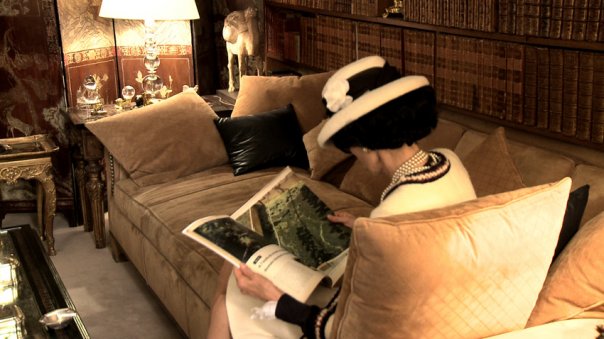
Which isn't to say it lacks focus.  31 is in fact an incredible distillation of a pretty complicated series of impressions about Chanel, the house and the woman, apocryphal and otherwise, and it might be best to think of it like one of the iconic photos depicting Chanel sitting in one of the address's rooms, her stare and her surroundings inviting projections about luxury, beauty, and the past.  31 lasts reasonably well, though it drifts sooner than later into a soft, powdery, floral melange, and rides things out from there, fading like a memory.

The photo above was taken on the set of the film made by Karl Lagerfeld in Chanel's former apartment at 31 Rue Cambon, and feels to me like the fragrance, a reconstruction based on iconic motifs, shapes, colors and silhouettes.

Friday, May 20, 2011

Old School Hermes: 24, Faubourg

It's ironic, I guess, that the current fragrance profile at Hermes is regarded as sophisticated, elegant, and refined, while the fragrances themselves are largely so wan and vegetal.  I won't say the things in house perfumer Jean-Claude Ellena does for the brand aren't elegant, but they define elegance in a pretty different way than I would - in or outside of Hermes.  This speaks to changing times, and what is generally considered chic these days, probably:  clean, effervescent, sparkling, and austere.  Yet no fragrance spells out what I think of as "Hermes" to me more adroitly than 24, Faubourg, a fragrance which has to be the quintessential antithesis of something like the cold-hearted, icy thing which is Kelly Caleche.

24, Faubourg is creamy and ornate, without feeling particularly heavy to me.  In fact, the top notes are practically sunny.  It resembles another ornate fragrance, Ysatis, in certain respects, characterized by a rich floral accord with deep amber tones, but lacks the dusty incense quality of Ysatis, feeling somehow quieter, though neither could be said to whisper, exactly.  Ysatis dates back to 1984, preceding 24, Faubourg by nearly a decade, and it's interesting to see how little the cultural idea of opulence they represent changed in the intervening years, especially when you look at how drastically these fragrances differ from Ellena's fairly recent work for Hermes.  Faubourg is not a particularly large leap from 1984's Parfum d'Hermes (now Hermes Rouge), speaking much the same language, if using different verbs.

Like Rouge, 24, Faubourg is a chypre.  The listed notes are bergamot, orange, peach, hyacinth, tiare flower, orange flower, jasmine, orris, sandalwood, patchouli, amber, and vanilla, according to osmoz.com.

I have two versions, one of which is the original edt, the other of which is a more recent eau de parfum.  There is very little difference between the two, except in respects to longevity and projection.  For me, the edp stays a little closer to the skin but is richer and creamier.  The edt isn't exactly lighter, and I can smell more of the vanilla and patchouli.  It doesn't last quite as well as the edp, but it's hard to say exactly, as neither concentration is anything close to a lightweight and the edt projects a little more, giving it the illusion of more mileage.

24, Faubourg is the very best of Roucel's work, and seems to have a clarity and a resolve that some of his more contemporary fragrances sometimes lack.  It's a statement, a declarative thing, compared to something like Dans tes Bras, a fragrance Roucel created for the Frederic Malle line.  Dans tes Bras is no less forceful, but it feels muddled and morose by comparison to Faubourg, as if Roucel were struggling a bit to adapt his style to changing times.  Dans tes Bras makes a valiant effort to hold onto the old school opulence of Ysatis and Faubourg but ultimately mumbles a little incoherently, insecure in its point of view.

Faubourg is a lot more confident in outlook and execution, I think.  It sits very comfortably within the range of chypres from the eighties and nineties.  It knows it belongs there, and that "there" is a perfectly good, even enviable place to be.  It's rich and intense and feels like a coat you've worn for years and wouldn't dream of giving away, knowing they don't make it anymore and nothing new will ever feel so wonderfully lived in.  I suppose the biggest difference between Faubourg's kind of thing and Hermes by way of Ellena these days is the sense I get from the Ellena fragrances that they are a little like trying to keep warm in a still-wet watercolor.

Tuesday, January 11, 2011

Paloma Picasso Mon Parfum


Watching youtube videos last week really stumped me.

There are what seem like thousands of tween girls reviewing their favorite perfumes online, if not their entire perfume collections. I'm in love with all of them--and addicted to watching them. It made me think about recent comments made by more seasoned bloggers alluding to the idea that there are way too many people blogging about perfume. It's just too noisy, they seem to be saying. It's just too messy. Obviously, these bloggers haven't sullied themselves by visiting youtube much in recent years. Bloggers don't stand a chance in that thicket.

It's amazing to see how many people out there love perfume, and want to share it with you. I appreciate what they do--how earnestly they approach the subject. Some of these girls have made me a fan. They bring you right into their rooms and break it all down for you--whether it's Britney Spears Curious or Donna Karan Signature. Far from making me feel threatened, their enthusiasm and ubiquity have paralyzed me with admiration. You don't hear much talk from them about the perfumers behind the perfumes they love. You don't hear much about their pyramids, provenance, the fragrance industry, sales figures, or ad campaigns. Typically, these aren't technically reviews. On a basic level, they're purely personal--this is what I like and why--so personal that you realize nothing else ultimately counts for much. These girls state the case so effortlessly, some of them, with so little guile or fuss, and so much personality, and here I am, plugging away at this post about...

Oh yes: Paloma Picasso.

Tuesday, February 9, 2010

Parfums de Nicolaï: Week-end a Deauville

Week-end a Deauville (WaD) is a pleasant surprise. When I read about the two springy launches from PdN last year I was most interested to try Violette in Love. Violette in Love was nice enough but it didn’t knock any of my favorite violet fragrances off their pedestals. I took my sweet time getting around to buying a bottle of WaD and lo and behold this is the easy winner of the two.

Why do perfume houses do this to us Americans and make certain fragrances exclusive to Paris (or Europe?). Is there a financial/profit issue I’m not understanding? For instance, I’m trying to get a bottle of Roja Dove Scandal and the Roja Dove website is under construction and I don’t think the other stores that carry it ship to the U.S. Week-end a Deauville is another one of these non-exports. So, this is another reason why it took me a lot longer to try this little gem.

Weekend a Deauville is a bright, cheery, sparkling, effervescent, dry citrusy floral chypre (enough adjectives for you?). It reminds me of Chanel Cristalle except without the sharp galbanum claws; in comparison WaD is a gentle little pussy cat who is so darn adorably soft and purrs so happily on my skin. I like Cristalle but sometimes she just claws me up a bit. I don’t think The Scented Salamander was as taken with WaD as I am. She describes it as simply pretty and nice for a casual weekend getaway, making the name perfectly fitting. I agree with The Scented Salamander where she writes that this is an unusual chypre in that it’s casual. Most chypres strike me as rather formal fragrances, too, but WaD is resolutely fun, fresh and flirtatious; words I would not normally use to describe a chypre.

For a citrusy chypre, WaD’s longevity is exceptional. Usually citrus notes are the most fleeting but here the combination of citrus and galbanum last and last. This is a huge accomplishment in my book. Week-end a Deauville begins citrusy and green and actually stays this way. The florals are lily of the valley, hyacinth, mimosa and rose and I don’t detect any of these individually, and the overall floral thrust seems an early spring bouquet – delicate and charmed.

I’m quite taken with Week-end a Deauville; so much so that if I had tried it in 2009 it surely would have made my favorites of the year list.

Notes include: essence of Italian bergamot, petit grain from Paraguay, galbanum, lily-of-the-valley, rose, mimosa, pepper essence, pink pepper, clove, oakmoss absolute and styrax balm

Monday, November 23, 2009

Incense Rose (Andy Tauer)

I'd read a lot--and heard even more--about Tauer perfumes before ever smelling any. People seem particularly fond, if not outright gaga, over L'air du Desert Marocain and Lonestar Memories, for instance, and the blogosphere is a'twitter with praise and testimonials about them. Vetiver Dance, one of the more recent Tauer releases, was greeted by the kind of anxiety you normally see associated with the next installment of the Twilight "saga". Even Luca Turin sang Tauer's praises, giving the majority of his work high marks, exempting the perfumer himself from the Guide's famously scathing wit.

During a trip to Los Angeles, I stopped in at the LuckyScent scent bar to see what all the fuss was about--but there was such a cacophony of smells competing for my attention that Tauer's fragrances didn't get the time they deserved. Stupidly, I decided that they must not be my thing. They hadn't knocked my socks off, so how could they be all that, I figured. This is a bit like saying Shalimar is inferior to Britney Midnight Fantasy because the latter sticks with you like blueberry gum, drowning out the former, along with memory, desire, hunger, and sex drive.

Dissolve. Months later, I received a little sample atomizer of Incense Rose in the mail. I think every perfume lover has those moments where he realizes how very little he knows, despite relentless exposure to everything from Guerlain to Lutens to Parfum D'Empire to Axe Body Spray. We smell so many things so often that we can sometimes mistake overkill for sophistication. Sometimes, we can discern what the average consumer can't--the finer points of Jicky, maybe, seeing past the civet. Other times, we're too jaded or distracted to recognize the quiet voice of greatness.

By itself, Incense Rose stood out. It rang out, really, and I was inspired to revisit all things Tauer, realizing that, in my rush to smell the trees, I'd missed the forest altogether. Incense Rose is pretty straightforwardly lovely, and truly unisex, a rich, calming blend of rose, frankincense, cardamom, coriander, and cedar, among other things. Osmoz.com classifies it as "Chypre - Floral". There's certainly a bit of an old school feel about it, a textured resonance associated with vintage classics, right down to the patchouli and ambergris in its base. But Incense Rose is unmistakably about frankincense.

Castor and labdanum add touches of honeyed leather, a subliminal undercurrent of the animalic. Orris bridges the distance between the more medicinal and astringent aspects of the incense, spices, and cedar and the buttery floral warmth of bergamot and Bulgarian rose. Incense Rose is so well done, so perfectly constructed, that you don't realize how complex it is, how adeptly all these materials have been selected, measured, and applied. Frankincense is treated in such a way that the overall radiance feels fairly straightforward, sort of inevitable, as if simply characteristic of the note. It's only when you compare it to other frankincense-based scents that you really see how epic Incense Rose is, how heightened and dynamic a fragrance, how advanced Tauer's artistry has become. None of this gets at the weird balsamic heft of the construction, mind you.

Incense Rose uses high quality ingredients. One smell of any Tauer perfume and you won't need me or anyone else to tell you that. Next to Lonestar Memories (another personal favorite) Incense Rose seems to last better than anything else in the Tauer arsenal on my skin. It sticks with me all day, fluctuating with my moods. There are only a handful of fragrances I'd never be without. Incense Rose has a firm place among them.

Thursday, October 29, 2009

La Prairie Life Threads Platinum: A Review in the Form of a Story

I'm sitting under a flowering tree with an old acquaintance, a pretty lady whose name I forget. The tree is weeping tiny petals. They fall into her long brown hair, a fragrant confetti. She has a faraway look, as if she's thinking back. I try to think back with her. Something in her expression is so familiar. I feel like we've been here before, that this moment is the sum total of many afternoons past. I can't put my finger on it, and the narcotic smell of the air clouds things even further.

We packed a lunch in an old leather box: French bread, a bowl of ripe plums, salad with a vinaigrette, red wine, a block of cheese. Cardamom and the bitter insides of the box mingle with the food on our breath. Ants make lazy, filigreed patterns across our gingham blanket, gravitating toward the woman in ever-elaborate formations. They've come all this way to find her, I think to myself. They traveled through tall grass, single file. The scent of the petals, maybe, which have asked a question they want to answer. Maybe they're drawn to her golden chiffon scarf, the way the petals settle there, as if in mid air, floating on a shifting cloud of colored smoke. She doesn't seem to notice their advance. She's gripped by a memory only she can see.

Maybe she's my mother, and this is a shared memory. We're in it together, only I'm so deep inside it I can't place it in time. It might be my grandmother, and this smell around us is the memory of sneaking into her bathroom so often as a boy, that little bottle in her medicine cabinet, something which smelled her age, telling me when I put it to my nose where she came from, what it felt like there, years ago. The faint smell of ash must be her cigarettes. I felt separated from her, smelling her past so secretively. Connected, but cut off. The woman might be a mirage; a figure in a dream. Maybe I'm dreaming about my childhood and an interconnected series of perfumes which speak from that place. Cabochard, Miss Balmain, Azuree, Diorling.

The wind blows through the woman's hair, stirring up the petals there. They scatter and dance about on her scarf, frantic polka dots, skittering under the layers of chiffon. The breeze brings in the last of the ants, speeding their arrival. On their backs they carry a disconnected bouquet of flowers: iris, jasmine, rose. The cargo is nestled in a bed of oakmoss. All of us are gravitating towards the same central point of some unspecified feeling. The flowers are trying to speak for the ants, they've arranged them into words, but I don't speak the language, and the woman, who might know it, is too distant to translate.

Tuesday, May 5, 2009

Y by Yves Saint Laurent: Chypre-perfection

I’m considering a group called “CA” to stand for Chypre-holics Anonymous. If anyone out there is addicted to green, mossy, dry floral chypres who hasn’t tried Y by Yves Saint Laurent, well, there’s no doubt you’ll become a lush over it. It’s easy to binge on Y. Y is utterly flawless. It’s green and dry and fruity and mossy and feminine and masculine and classic and sophisticated and elegant and soft and sensual and, to finally end this list of adjectives, it’s simply perfect.

Y was the first fragrance created by the house of Yves Saint Laurent in 1964. I’m a chypre fanatic, but I actually do understand how chypres can come off as being dated for many people. For the past 15-20 years, chypres have not been popular. I’m still shocked that Ralph Lauren Safari, created in 1990, was discontinued. Safari is a stunning chypre. Since chypres haven’t been trendy, they aren’t worn or smelled very often, and due to this, the main association for most people is of “old ladies” because chypres were last popular during our grandmother’s generation and many classy old broads still wear their favorite gorgeous chypres. Even so, I think Y is a chypre that can easily get away without the “dated or old lady” stamp. Comparing Y with Miss Dior or Mitsouko for instance, Y is much less obtrusive, less potent, lighter, cheerier, spring-like and gauzy. Don’t get me wrong, I love even the heaviest of chypres, but Y should win awards for its ability to be present and longwearing yet sprightly and innocent.

It’s springtime in my part of the world and this is precisely when I long to wear Y the most. Y is the only chypre I associate with spring, with green buds and flowers. Y starts off with one of the most beautiful bursts of galbanum I’ve ever experienced. I hate to go overboard but this green burst is so breathtaking, it brings to mind a dewy fiddlehead fern slowly unfurling at the edge of a meadow in late April. Y starts sharply green, but it over time it loses its sharp edges and becomes a soft fruity, floral, mossy dream. Y is often compared with Vent Vert and Ma Griffe because they have many notes in common. Both Vent Vert and Ma Griffe are lovely green fragrances and there are certainly days when Vent Vert, especially, is the answer, though I find them both a little bitter and synthetic in comparison. Y is fresh, in a natural and realistic manner.

If you look up Y on basenotes or makeupalley you’ll see it’s called the perfect office scent by many. I understand this is because it’s not offensively heavy or strong, but I feel compelled to point out that this doesn’t mean Y is boring. On the contrary, Y, for me, is an adventure. Every time I wear it, I enjoy Y’s phases, especially the initial green burst, like a gun shooting galbanum bullets. Y’s drydown is soft, gentle and somewhat soapy-powdery-musky. As always, I feel all fragrances are unisex, but Y isn’t even a stretch, it easily goes both ways.

Long live Y

Y’s top notes include galbanum, gardenia, peach and honeysuckle; heart notes are rose, jasmine, orris, hyacinth, and ylang-ylang; and base notes are oakmoss, amber, patchouli, civet, vetiver, and benzoin

Here’s another review of Y, from Angela at NST

While googling for an image of the Y perfume bottle I found these chic boots by Yves Saint Laurent. How cool are these?

Sunday, April 26, 2009

Sisley Soir de Lune (2006): A Review

I thought I read that Dominique Ropion created Soir de Lune for Sisley. I was a little surprised, but within 45 seconds I had found it on parfum1.com and bought it using their 25% off code. Soir de Lune arrived; I sniffed, I swooned, I love it, but now I can’t find the reference to Dominique Ropion being the perfumer. Perhaps he wasn’t. UPDATE: Turns out Soir de Lune *is* a Ropion creation

Nevertheless, Soir de Lune smells like a Ropion masterpiece. It’s a full bodied spicy, floral chypre, which somehow manages to be fresh, clean and classy. Soir de Lune literally translates to Moonlit Evening in English. Perhaps the name infers Soir de Lune is meant to be a decadent evening fragrance, but I would happily wear it anytime/anywhere. This is also why I’m writing about it on a 92 degree day in New Jersey. While Soir de Lune is a luxuriously full bodied and present perfume, it is also fresh and gauzy enough to wear in warm weather. I wore it last week on a dreary, chilly, spring day and just loved its spicy floral notes. Today was the hottest day so far in 2009 and somehow Soir de Lune managed to show me it’s fresh, clean, almost soapy-green-dry side. It really is a marvelous little wonder. Soir de Lune certainly envelopes the wearer and has potent sillage but miraculously it doesn’t overwhelm. I think of fishnet stockings, which cover the skin, but not completely, allowing all sorts of skin to poke through. Soir de Lune, like a pair of fishnets, provides a dramatic entrance, but allows the wearer to emerge, never overtaking.

Soir de Lune is one of those perfumes where a list of notes doesn’t give you a clear picture. I would describe it as a modern chypre, with a clearly defined citrus top, floral & spicy heart and woody base. Soir de Lune has the “dancing” quality of well done modern chypres, which causes the scent to be multi-faceted instead of uniform. The notes swirl around you allowing you to smell different aspects of the composition throughout the day. At times, Soir de Lune has a blazing rose heart, reminding me of Ungaro Diva, except subtract the heaviness of Diva and add a dose of modern freshness.

Notes: citrus, bergamot, mandarin, lemon, coriander, nutmeg, chili pepper, rose absolute, mimosa flower absolute, jasmine, lily of the valley, iris, peach, tree moss, musk, honey, sandalwood, and Indonesian patchouli

Rating: 5 stars
Sillage: perfectly potent
Longevity: excellent, all day or all night

The cap of the bottle is a bit tacky (sigh) but overall the fragrance is so good I'm starting to find it charming...

Tuesday, April 14, 2009

Acqua di Parma Profumo: don't overlook this chypre

As a lover of classic dry chypres I happened upon Profumo a few months back. I already had Acqua di Parma's Colonia, Iris Nobile edt and edp (both gorgeous) and
Colonia Assoluta. I like Acqua di Parma - their fragrances are all good to excellent
and it's hard not to appreciate the solidly simple bottles and screaming yellow
boxes (although the Profumo I have came in a bright red box). Both AdP's branding
and their fragrances are classic and well done.

When doing some research for this review I noticed that Marina over at Perfume Smellin'Things beat me to the punch - she did a nice review of Profumo last year. Marina is right on - Profumo is easy to acquire (now sold at Sephora), not terribly expensive, and excellent. Profumo is a chypre along the lines of Chanel's 31 Rue Cambon, and Ralph Lauren's Safari (though must less powerful than Safari).

I love pointing out overlooked gems. Profumo isn't mentioned much on POL or MUA.
31 Rue Cambon is splashed all over the place - not surprisingly since it's gorgeous - plus it's Chanel so there's the whole brand mystique going on there. Safari get's mentioned here and there - it was created by Ropion and it's discontinued so go buy some while bottles still remain! But Profumo, around since 1930, is exquisite and boasts over 300 separate ingredients.

Profumo is a classic retro styled chypre. I've been thinking about it lately because
I'm writing up my list of "must purchase" back up bottles now that the ghastly restrictions going into effect on January, 2010. Profumo is a dry, woody, floral chypre. Exquisite and classic are the adjectives that immediately spring to mind. I also think of custom tailored suits and tastefully elegant couture the likes of Gwenyth Paltrow and Nicole Kidman. Profumo is elegant and refined in an "old money" sort of way. This isn't the fragrance of a brassy, flashy new starlet. Profumo is the fragrance of someone with the aura of Catherine Deneuve. Profumo surrounds you in an aroma that seems confident, talented, wise, articulate, witty and beautiful. If you love perfume as much as I do you'll understand how it's easy to understand the personality of a perfume. Profumo has a personality that I aspire to - and like to wear on certain days, for specific instances where I want to exhibit these
traits. Of course, I can see how a person would like to wear this everyday, easily.

Is Profumo unisex? Of course.

The scent of profumo is one of those abstract chypres that's impossible to describe. Overall its dry, slightly woody, slightly floral and just a smidgen of the smoothest powder. On me, Profumo wears somewhat lightly, it's not a big blast of perfume, but a 'just right' average amount of sillage and longevity.

Notes-
Top: bergamot, ylang-ylang and peony;
middle: jasmine, rose, French labdanum and amber
Base: oakmoss, patchouli, vetiver, sandalwood and musk.

Tuesday, February 24, 2009

Safari by Ralph Lauren


Ralph Lauren launched Safari in 1990 and it was created by nose Dominique Ropion. It is now discontinued and this is such a shame, for it is a classically gorgeous chypre.

For those of you who are chypre-loving fragrance fiends Safari seems a must-have. Given the long list of notes for Safari, I find it to be rather dry and crisp and so easy to wear. Safari is potent, but just enough to last, never too much or overwhelming -- for me it’s the perfect balance of sillage and longevity.

Safari begins with a galbanum, green notes and a citrus blast, which soften quickly letting the floral heart present itself. None of the florals claim their identity to me – it’s mostly a lovely green floral on a bed of dry woods, musk and patchouli. The bitterness of many chypres is not present in Safari – yet it still maintains its gorgeous dry and green quality without ever seeming sweet. Safari seems utterly sophisticated in a classy and well-mannered way – Safari isn’t too showy and perfect for very nearly any occasion. There are many modern chypres which really smell like flor-ientals to me these days – Safari smells like a complex and beautifully rendered chypre, a true chypre, to me. I feel compelled to say it again, it’s such a shame Safari was discontinued.

You can still find Safari at many online discount perfume shops. If Safari is one of your favorites you might considering hoarding a few bottles in case it becomes one of those highly coveted scents going for $300-500 on ebay in the future.

Safari’s notes, from basenotes, are listed as:
Top: Galbanum, green notes, mandarin, aldehyde, hyacinth, orange daffodil, blackcurrant
Heart: Muguet, rose, narcissus, carnation, orchid, honey, jasmine
Base: Cedar, musk, vetiver, styrax, vanilla, amber, tonka bean, patchouli

...and the bottle...it's so beautiful....

Wednesday, October 8, 2008

Ava Luxe Mousse de Chine: A Review


Mousse de Chine is a delightfully wispy chypre from Ava Luxe. That is, if Mousse de Chine technically is a chypre at all. In my book chypres open with some aldehydes and dry down to a deep, oftentimes heavy, base containing oakmoss and/or patchouli. Mousse de Chine does not appear to contain aldehydes but oakmoss, labdanum, ambergris and musk are among the list of notes.

Chypre or not, Mousse de Chine is a lovely fragrance. It opens with a bergamot, citrus, soapy accord that is refreshing, clean and jubilant. Then it settles into a slightly powdery, musky, mossy aroma. I expected Mousse de Chine to be much heavier and I’m pleasantly surprised at its delicate composition. Likely it’s because I know lavender is among the notes but I do detect an herbal aroma that makes me take deep meditative sniffs of it. Mousse de Chine is yet another fragrance from Ava Luxe that I really enjoy.

Longevity: Excellent ~ 4-5 hours or more
Sillage: Soft to Average

Notes: bergamot, lime, fern, lavender, amber, Spanish moss, oakmoss, labdanum, musk, ambergris.

Mousse de Chine can be purchased from the Ava Luxe Website


pic: Underwater Dreams by *SAB687 on deviantart.com

Monday, August 25, 2008

Aramis 900


It’s difficult to imagine anyone but Bernard Chant behind Aramis 900. After all, he made everything else that smells like it, excepting Bandit.

Released in 1973, Araqmis 900 is a woody, herbal masculine with a bright cirtus opening and a dense, deep rose heart.

The fragrance has a slightly fecal, animalic character, most noticeably up top, and relates to the chypres Chant is famous for. It has the tang of Aramis, Azuree, and Cabochard, not just up top but at the base, likely from vetiver, and their floral embellishments too.

Luca Turin was surprised to learn that today's Aramis is nearly identical to the old Cabochard. It might surprise less seasoned connoisseurs just how similar Aramis 900 is to Aromatics Elixir. What surprises more than anything is how little difference there is between them. If they're brother/sister fragrances, then their relationship is decidedly incestuous.
It goes some way toward indicating how conditioned we are to segregate fragrances down a gender divide. Once the marketers have assured us enough that one can be safely worn by women and the other by men, we separate them in our minds, convincing ourselves the distinctions remain safely in place. A similar phenomenon tends to happen in general with fragrances, complicating things. Until someone points out the marked presence of violet in Halston, you might smell only “floral” and “woods.” Once you’re told, you can hardly smell anything else. That smell is deeply tapped in to memory is old news. Few explore how suggestible the sense is.
The truth is that if you’re inclined to wear 900 you might as well cross the aisle and pick up AE instead. While both are strong, AE is stronger, its rose less apologetic, its sillage more robust and therefore perhaps manlier than its male counterpart. Aramis 900 handles rose beautifully, despite or even due to that fecal note (those who go on about a dirty rose clearly haven’t yet smelled one rubbed in dog mess) but there’s no denying that 900 ultimately smells like the faint whiff left once AE leaves the room.
Aramis 900 runs about 45-50 dollars for 100 ml. You can find it sometimes in the department store with the Aramis fragrances for men.