Showing posts with label Frederic Malle Le Parfum de Therese. Show all posts

Friday, December 31, 2010

2010 in review (version Abigail)

2010 was the year I became exhausted from the onslaught of new releases, most notably the high end niche market. 2010 was also the year I began to lose hope for the future of mainstream perfumery, given that Celebrescents have taken over the market and aren’t going anywhere. It was also the year I found the largest number of reformulations; some of which people aren’t even talking about. I adore vintage perfumes, but I can’t spend my time chasing rainbows, I would much rather find something current and fresh than chase expensive 35 year old vintage bottles whose top notes have been lost.

On the whole this was the year I’ve been the most annoyed, jaded and least excited about anything happening in perfumery. But I’ve forced myself to stop and take note of the fact that if I’m still enthused about a handful of perfumes each year, well, that’s all it takes to keep the fires burning. As long as there are a half dozen or so perfumes that rock my world, whether they be new releases or plain old new to me, that’s what this hobby is all about. Because, let’s face it, I can only wear and enjoy so many fragrances in my lifetime and finding 5-10 winners each year is enough bounty to add to my already burgeoning collection.

It also hasn’t helped that, as Brian has already mentioned, I, too, felt a similar frustration with a strong current of snobbery, elitism and hypocrisy in the perfume blogosphere. For me, this fueled a sense of disinterest in perfume. I finally decided that I should continue to write because I want to offer the perfume community exactly what I, myself, set out to find when I read other blogs. I will continue to write and read only honest, enthusiastic, passionate, moving and fun posts. I would never write and will avoid reading anything with a snobbishly critical tone or a veiled intention or affiliation. I love smelling perfume and that’s all I’m here to communicate.

One thought I’d like to include is that I am so thankful for YOU. The biggest reason is that you make me feel LESS WEIRD!! This Christmas I visited family in North Carolina and for a solid week I felt like an oddball with a strange habit. Three times (not once, not twice, but THREE TIMES) my Mother told me that “so-and-so” requested I not wear perfume when we went out. The craziest part is that all three times were individuals I have never met before so they couldn’t have previously met me whilst wearing a kiloton of Shalimar. I’m sure my Mother mentioned to these folks that I have a business and a blog that’s all about perfume and these individuals decided they didn’t want to spend even a few hours around someone who might be wearing scent. Nobody in my family, extended family or even the endless encounters with Mother’s friends was remotely interested in perfume; they just wanted to be sure I wasn’t wearing any. This made me realize what a unique community we have here. I appreciate you and I value your interest in perfumery and I am hopeful that our numbers grow so I don’t have to spend much time feeling like a crack addict billowing wafts of Alahine in a corner by myself. It’s amazing how many suddenly have asthma when the topic of perfume comes up. Perhaps needless to say, I didn’t wear perfume for an entire week. I only wore it to bed at night.

2010 was the year I found a few beautiful new releases as well as a few scents that were just new to me. Typically I’m a lover of orientals, florientals and chypres but I found myself enjoying a bunch of sheer, light, seemingly simplistic beauties in 2010. Here’s a stream of consciousness list:

Atelier Orange Sanguinne and Trefle Pur: The entire Atelier line is about pure and natural smells. These fragrances smell so realistic, gorgeous and simple it’s easy to overlook them. If you’re like me and tend to prefer orientals, chypres or anything complex you might think “oh yawn” when it comes to a line like Atelier. But, honey, I gotta tell you, Atelier is killer in warm weather. Orange Sanguinne is the juiciest and most pure and realistic blood orange I have ever smelled. On me, Orange Sanguinne never goes sour; it stays perfectly zesty and sweet. Trefle Pur is a softly green scent, all meadows and clovers; it’s so simple yet so perfect for those occasions when you desire a refreshingly cool green scent.

The Different Company de Bachmakov: The Different Company has some great fragrances, most notably Sublime Balkiss and Oriental Lounge. TDC de Bachmakov is a treat for lovers of tea and spices. It wears softly yet stays with you through most of the day. It’s unusual but not overly so, you can wear this without feeling a little odd.
Canturi eau de parfum: I should have reviewed Canturi earlier. Canturi is an old school oriental fragrance. My only complaint is that I wish it was a bit more potent and projected more as it’s rather soft and subtle for an oriental. Canturi isn’t groundbreaking or unusual, rather it’s a classic oriental which was released in 2010, a year in which most releases were anything but classically styled. This alone is why I like it so much. Canturi leans toward the Far East for me; it’s very much an Asian inspired oriental. I smell dry plums and sake and it’s never especially sweet, it’s exceedingly understated. Canturi is a gorgeous oriental housed in my favorite bottle of the year.

Annick Goutal – the whole line: It was earlier this year that I stopped to realize just how exceptional everything from Annick Goutal is with a week long series on several fragrances from AG. There are so many beauties from AG and their newest fragrance called Rose Splendide took me by surprise. I’m never looking for a rose soliflore, but Rose Splendide is not just a rose soliflore. Instead, it’s an intensely green rose, think of the privet scent in AG’s Eau de Camille and add a dash of fresh roses – that is Rose Splendide. Rose Splendide is another one which seems so simple and sheer yet manages never to turn sour the way some rose scents do and also maintains its own unique green character in an endless sea of rosy fragrances.

Guerlain Chamade: I’ve always liked Chamade but just this year I took the time to actually wear Chamade, not just sniff it, and I fell hard. Five years ago, I would have said there was a strong ‘hair spray’ note in Chamade but somehow this has vanished for me. Chamade is astonishing and I’m trying to figure out why I think I must have it in pure parfum. I have so much perfume yet I feel I need a bottle of Chamade in pure parfum. Like soon.

Dawn Spencer Hurwitz: DSH is an enormously talented perfumer and I personally find her orientals and gourmands to be fantastic. This winter I’ve been enjoying Mahjoun, Cimabue and Parfum de Luxe lots and lots. DSH American Beauty is one of my favorites, if not my most favorite, rose perfume. American Beauty wears well year ‘round but I especially enjoy it in winter.

Frederic Malle Le Parfum de Therese and Dior Diorama: both are sublime creations from Edmond Roudnitska; Diorama was created in the 1950’s and Le Parfum de Therese is essentially Diorama’s modern offspring. Diorama wears like an evening scent on me and LPdT feels like a brighter, clearer day-time scent.

Serge Lutens Bas de Soie: a seemingly simple, sheer and lovely Lutens. Bas de Soie snuck up on me and I love its soft iris/hyacinth/Chanel-esque charms. I like it more than Chanel 28 La Pausa which only lasts 17 minutes on me. Bas de Soie lingers for awhile.

Profumi del Forte Roma Imperiale: I previously reviewed this one; it’s basically the softest and most beautiful oriental wrapped in bunny ears.

Honorable mentions:
Jean Patou Joy: I know, this is about as exciting as listing Chanel No. 5, but have you really worn and smelled Joy lately? It’s an animalic floral with attitude by the suitcase.
Guerlain Mitsouko Fleur de Lotus: WHY was this limited edition? It is so incredible!
Ormonde Jayne Tiare: reminds me of Chanel Cristalle but I like it even better.
Solange Cosmic: I’m fixated on this one lately.
Teo Cabanel Alahine: my BFF 4-evah
Vetiver & Leather quandary: I’ve finally concluded my efforts to find a vetiver and a leather that I like. I’m throwing in the towel on vetiver fragrances; I hate them all. I like some classic fragrances considered leathery like Robert Piguet Bandit, but for the most part I don’t like anything that’s strongly leather focused; with the exception being Tom Ford Private Blend Tuscan Leather. Tuscan Leather is dry and herbal and reminds me of the New Mexico desert. It reminds me of cowboys riding on worn leather saddles. This one I love, especially on men.

Happy 2011 to all! And thank you so much for being here :)

Other participating blogs:
Scent Hive
The Non-Blonde
Smelly Blog
Roxana Illuminated Perfume
DSH Notebook
EauMG
A Rose Behind the Thames
All I Am a Redhead
Schreibman's Live
Portland Fragrance Examiner
CaFleureBon
Persolaise
Sorcery of Scent

Friday, July 16, 2010

Parfums Delrae Emotionnelle


Back when it first came out, I wasn't thrilled by Emotionnelle. I guess this was over a year ago now. It seemed like some kind of departure for Delrae, an important shift, though I couldn't put my finger on what kind. Anytime Emotionnelle's creator, Michel Roudnitska, produces anything even remotely evocative of his father Edmond's oeuvre (Diorelle, Parfum de Therese, Rochas Femme, Eau Sauvage, et al), comparisons are begged. And most of Roudnitska, Jr.'s fragrances seem speak to that heritage in some way, so the conversation about Emotionnelle was road-mapped before it ever hit my skin.

The strong melon thrust of Emotionnelle can certainly be seen as an homage to Parfum de Therese and Diorella. It can be seen as somewhat retro in a certain sense; not just because it recalls that vintage stock but because it doesn't align itself with any contemporary trend that comes to mind. I would never say there's no relation between Emotionnelle, Therese, and Diorella. How could you? But something about that comparison turned me off, I now realize. Again, I can't tell you what; but I think it's a bit of a trap door.

True, Emotionnelle feels retro, but it doesn't feel as spring-like to me as Diorella or Therese. It feels more like an oriental, actually, what with the clove, cedar, and amber in the base. Even at the top, when the melon is strongest (it's strong all the way through, mind you), there's something barbed about Emotionnelle, a sharper edge missing from Therese and Diorella. Emotionnelle feels darker and spicier than I thought at first, and ultimately a comparison to Rochas Femme might be more apt.

Like all of Roudnitska's work for Delrae, Emotionnelle has exceptional persistence and projection. Of all the coin I've laid down for perfume, the money I spent on the first five Delrae fragrances seems most intelligently squandered. I've written about the first four and about Roudnitska's work in general before. For me, he's a sensualist on the level of Maurice Roucel and Sophia Grojsman. What distinguishes him is a quality which can make his fragrances feel ten miles deep and horizons wide. The work of Roucel and Grojsman is by no stretch shallow or narrow, but the end effect, while plush and often robust, doesn't feel particularly voluminous. Both create perfumes which seem to have ripened right on top of the skin. Grojsman's Yvresse is a good comparison to Emotionnelle, with its boozy peach focal point. It feels more concentrated, more intensely pin-pointed.

Emotionnelle takes you down into the soul of something and spreads its arms out to bask in the full breadth of its splendor, and I get the feeling that Delrae decided, after it, to move in another direction, something considerably less epic in scale. The last two fragrances in the line up were created by Yann Vasnier. The word you hear most often in relation to these is light. The word you heard most often in relation to Roudnitska's perfumes for Delrae was heavy. I would subtract the "v" and add a "d", myself. I'm not sure vendors knew how to sell or market those first five Delrae perfumes. The one place here in town which carried them has stopped updating their stock. They still have boxes of Eau Illuminee and Debut on the shelf, collecting dust. I suspect Delrae felt a need to change its point of view.

It happens. A lot, actually. A perfumer has a run or a relationship with a brand which can last two, three, or twenty perfumes. Would I have enjoyed seeing how the relationship between Roudnitska and Delrae played out over the course of a few more? Yes. And I'm not a fan of what Delrae and Vasnier have produced since their division. But change is always at least interesting, and I'm curious to see where Roudnitska goes from here. For some reason, I feel that Delrae and Roudnitska tried working through their relationship with Emotionnelle. I feel it might have been each party trying harder to make the other happy. This is all speculation. But something about Emotionnelle felt brighter to me than the first four Delraes.

Either way, I'm sorry I misjudged it. I'm glad my expectations were high enough that I purchased it unsniffed. And I wish it hadn't taken me a year to come around to its charms. But it's becoming clearer and clearer to me that sometimes a blogger can't expect to have an instant opinion about a newly released fragrance. Some you know where you're at with right from the first sniff. Others your feelings and mind evolve around. Emotionnelle is a special fragrance.

Thursday, January 28, 2010

Christian Dior Diorama (reissue)

Some important questions: Where has Diorama been all my life? How is it that it’s taken me this long to procure a bottle?

I have never smelled vintage Diorama. I’m afraid to look for it now. I’m in love with reissued Diorama, and feel the need to wear Diorama and only Diorama for awhile to make up for lost time.

Diorama reminds me of Frederic Malle Le Parfum de Therese (also created by Roudnitska), which I smelled first and fell in love with first. Diorama and Therese seem to be very close sisters, with Diorama outdoing Therese in the sillage and longevity department and also not showcasing any aqueous nature. To me, Diorama is a classic fruity floral, but it appears to be categorized by the experts as a fruit chypre. I’ve read there are base notes of vetiver, oakmoss, civet and patchouli but these are not discernable for me, not until the way dry down. Fruits and white florals are showcased here; it’s all about melon, plum and peach with jasmine, tuberose and very soft spices if you’re looking for them. Perhaps it is because of this fruity quality, with fruity floral fragrances being an enormous trend of the past decade, which makes Diorama seem completely modern to me. I thought the same thing when I first smelled Therese; it seemed strange that Therese was created decades ago, because any sort of fruitiness seems modern. Maybe it’s just my own perception but mossy chypres and powdery scents seem old fashioned, while fruity fragrances do not. The fruity quality in Diorama is light, bright, effervescent and blended with white florals and soft spices. There’s also some similarity to YSL Yvresse, which is another sparkling and classic fruity scent worth checking out.

I’ve read several reviews which describe Diorama as buttery. Oddly, Diorama is the opposite for me, it starts off rather sharp and only in the way dry down would I describe it as buttery. One spice I notice is saffron. I have no idea if saffron is among the listed notes, but I dig saffron and it works like magic here.

Coming of age in the 80’s I have the tendency to prefer big fragrances. Diorama isn’t crazy big, but it’s big enough to please me (smirks at perverseness of this sentence). I’m of the thinking that good sillage and longevity mean I’m getting my money’s worth. For those who read ISTIA regularly, you won’t need to ‘spray yourself wet’ with Diorama (smirking, again, what’s with the perverted minds?!).

I read a few reviews on other perfume blogs before writing my own and realized I have a very different experience with Diorama. Diorama doesn’t make me recall Paris or women in fur, pearls, diamonds and couture evening gowns. Instead Diorama smells youthful, gregarious, brimming with a zest and zeal for life. Diorama smells like the study of nature on an early spring day. The essence of Diorama is a verb; it’s budding, growing, juicy and bursting forth with fresh natural vapors and dewy realism.

Notes are listed as: melon, peach, plum, jasmine, rose and tuberose.

Monday, November 16, 2009

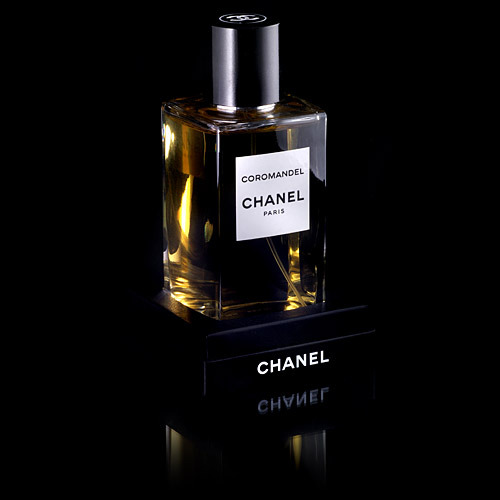
Coromandel: Second Opinion

Abigail reviewed Coromandel months ago during a Chanel intensive, and I remember thinking, "That sounds promising," but when I tried it at Nordstrom it struck me as being more than a little similar to Prada for Women--which meant a definitive No Thank You for me. As usual, I should have listened more closely to my co-blogger, because of course this stuff is leagues away from Prada (or anything else, really) and so good it's almost indecent.

I'm a fan of Jacques Polge and Christopher Sheldrake, the two behind Coromandel, and I do see a connection to Sheldrake's Borneo 1834, another fragrance adjectives fail. Is Coromandel Chanel's version of Borneo, as some have suggested? Probably no more than Diorella, by Edmond Roudnitska, was Dior's version of Le Parfum de Therese, also by Roudnitska. To be sure, Coromandel is closer to Borneo than to many of Sheldrake's other fragrances, but the contribution by Polge is significant enough that it fits resolutely within the Chanel line-up, not just its Les Exclusifs brethren but all the department store mainstays, from No. 19 to Allure, with a definite tip of the hat to Chance.

Coromandel has the trademark citrus shimmer that many of Polge's Chanel fragrances have, that sense of being illuminated from within, shot through with light. The most recent example of this tendency would be Chanel No. 5 Eau Premiere. The in-store displays for Eau Premiere feature a tiny light under each bottle, driving the point home. As far as I know, Sheldrake had nothing to do with the latest flanker to No. 5. Eau Premiere has a fraction of Coromandel's staying power, and none of its sturm und drang. Part of what gives Coromandel this sense of drama is probably its treatment of patchouli, a note it fully embraces. While few will characterize this as a head shop patchouli, no one will accuse it of transparency, either. Much has been made of the cleanliness of contemporary patchouli. Though definitely of its time, Coromandel has an earthiness the majority of patchouli-focused fragrances take pains to scrub away. For this alone, it sits alongside Cuir de Russie as one of the bolder iterations of the Chanel sensibility.

You'll find quite a dollop of vanilla in there, as well as amber, spices, woods, and frankincense. Coromandel broods around on the skin with a forcefulness that no other Exclusif displays. It smells of cosmetics periodically, specifically powder, and I would wager there are aldehydes in there, but none of these make it particularly feminine to me. Strangely, the overall effect is simultaneously subtle and robust, asserting itself with a sinuous stealth Ninotchka might applaud. Chanel calls Coromandel exotic and voluptuous, a "woody oriental", which is a bit like characterizing a Cadillac as a four wheel vehicle. For me, Coromandel straddles the gender divide with unusual finesse, making transitions back and forth as it plays itself out. Chanel says the fragrance pays homage to Gabrielle Chanel's passion for the decorative lacquer of the same name. The intricate, submerged intaglio of coromandel screens make an apt visual for the perfume's peculiar ambiance, rendering polished detail out of rough hewn lumber.

Lightning strikes twice, I guess. Last year, I received a half-empty bottle of Cuir de Russie from the Chanel Boutique in Beverly Hills. I assumed at the time that the leakage and the busted atomizer were due to magnificently silly packaging by the staff (several sheets of tissue paper and a lot of air space, if memory serves). Coromandel came in a box which was packed more meticulously than the cookies your grandmother sends at Christmas. Nevertheless, it too was half gone. The perfume was still in its cellophane wrap, and once I removed it I had to use a pen knife to pry open the Les Exclusifs container. That tells you something about the quality of oils used in these fragrances, so thick they served as glue with the addition of a little heat. The fact that the atomizer was askew suggests faulty design--or extraordinary bad luck.

Then again, I know that Abigail's bottle of Coromandel leaked significantly in the mail. That makes three, yet when I called Chanel to complain, the sales associate reacted as though I were reporting a Bigfoot sighting. "I've never heard of anything like that happening before," he said, adding very quickly: "I'm not saying I don't believe you." He didn't say he did believe me, and I had the distinct feeling it wasn't his first time around the block with this kind of phone call. At least they offered to send a replacement bottle, without asking me to return the first one. There's something vaguely tawdry and thoroughly inconvenient about returning a broken bottle of Chanel to Beverly Hills, as I was asked to do with Cuir de Russie. Call it insult to injury, or luxury goods buzz kill.

Tuesday, May 26, 2009

We Love Fruity Florals

I especially enjoy Angela’s reviews over at Now Smell This. Recently she wrote a piece on Keiko Mecheri Passiflora, which spawned many comments on how fruity florals can be wonderful and how we shouldn’t unilaterally pan this category due to it’s (clears throat) sheer abundance. There are, indeed, many wonderful fruity florals and I’ve been thinking about this over the past month every time someone writes a disparaging comment about fruity florals on the various blogs and fora.

I realize fruity floral scents tend to multiply in spades, but even so, there are so many great one's.

Here are some of my favorites:

Badgley Mischka ~ BIG, gorgeous fruity extravaganza. Still a very real and serious perfume.

Frederic Malle Le Parfum de Therese ~ effervescent basil, lemon, melon and peach on a bed of oakmoss. Gorgeous.

Teo Cabanel Julia ~ Tart fruity floral. Alahine (ambery oriental) and Oha (dark rose) are the two most discussed from Teo Cabanel but Julia is lovely for the summertime. Julia has a nice blackcurrant & rhubarb scent that I love.

Yves Saint Laurent Yvresse ~ Fruit champagne (Yvresse was originally named Champagne).

Parfums de Nicolaï Balkis ~ Tart roses, blackberries and cream.

Ava Luxe Johri ~ Johri is really interesting and nice. It’s mostly green and hesperedic; with figs and creamy coconut milk. Johri strikes me as joyous and great for the summer.

Jean Patou Colony ~ Green, leathery, animalic pineapple – what’s not to love?

Histoires de Parfum 1804 ~ technically 1804 is a floral oriental but there are strong fruity notes. Because pineapple is such a rare note in perfumery I tend to think of this as an homage to JP’s Colony. 1804 is a gorgeous scent with notes of pineapple, peach, gardenia, jasmine and cloves; on a bed of sandalwood, musk, vanilla and pathouli.

Annick Goutal Eau de Charlotte ~ Starts off like sticky fruit syrup but dries down to a lovely, cozy scent with blackcurrant, mimosa, chocolate and vanilla.

Keiko Mecheri Ume ~ Not sure if this counts as a fruity floral because it’s actually a woody plum. Ume is a dry fragrance, focused on Japanese plum, with a base of woods.

Keiko Mecheri Peau de Peche ~ with notes of white peach, orris, sandalwood and amber, Peau de Peche is a beautiful velvety fragrance meant to mimic the scent of peach skin. Peau de Peche is dry and woody, not fruity and juicy, and not especially sweet. This one is great.


What are your favorite fruity florals?

Friday, April 10, 2009

The Smell of Claude: Parfum de Peau, Parfum d'Homme, Parfum d'Elle, Just Me

A few months ago, I found a bottle of Montana perfume at the local discount drugstore. Half off the original price ($44), it seemed like a steal to me. Never mind the beat up blue box, the lid of which was barely hanging in there. Never mind the fact that the bottle was a dreaded splash. I wasn't that impressed with the scent when I smelled it, but at twenty two dollars it seemed like something I should have, and I bought it.

The box said, simply, Montana, in a script anyone who went to high school in the eighties would instantly recognize. I couldn't find anything about it online--on basenotes, on makeupalley, on the blogs in general. The consensus seemed to be that Parfum de Peau was the best of the designer's fragrances, but I'd never seen it. I had seen Parfum d'Elle, smelled it, and been turned off by it; specifically, a strange, off-note of piss-honey which reminded me of a syrup-drizzled variation of Miel de Bois. I'd also smelled Montana Blu, a later fragrance created by Annick Menardo (Bulgari Black, Lolita Lempicka, Le Labo Patchouli 24), a floral aquatic which bored me before I even brought the bottle up to my nose. I found nothing on plain old, blue box Montana, so I set it aside and forget about it for a while.
Imagine my surprise when, weeks later, I discovered that Parfum de Peau has also gone by the name Montana, and that the nose behind it was none other than Jean Guichard (Eden, Lou Lou, Obsession, Asja), whose work I've been appreciating more and more lately. It was later reformulated by another great, Eduoard Flechier (Poison, Une Rose, Vendetta Uomo) with synthetic castoreum. It blew my mind to think that this wonderful thing was sitting right on my own cluttered table, that I'd had it all along, that I'd been so disinterested when I first gave it a go. I smelled it again and wondered where my head had been the first time. Montana de Montana/Parfum de Peau is wonderfully bizarre in its way.

Michael Edwards classifies it as "chypre - floral", but initially it smells like your average eighties fruity floral, some of which might be due to its having inspired so many fragrances since its introduction in '86, however tamed its imitators. Deeper in, the scent is a revelation of finely calibrated opposites; peach and blackcurrant against pepper and cardamom, powerhouse tuberose against equally pungent ginger and carnation, with animalic leather tones lurking underneath it all. Even when compared to the fragrances of its day (between 1980 and 1985: Fendi, Jardins de Bagatelle, Jean-Marc Sinan, Obsession, Paloma Picasso, Vanderbilt, Giorgio, Paris, Poison, Calyx, Beautiful, Coco, Ysatis) Parfum de Peau comes out looking like a powerhouse. It has more in common with masculines of the time, sharing the off-kilter, urinous bombast of Kouros, and the animal growl of Lauder for Men, Dior Jules, and Givenchy Xeryus. Among its female counterparts, Paco Rabanne La Nuit comes closest in terms of the sheer, beastly nerve of Peau's base notes (castoreum, patchouli, civet), but even La Nuit, which will win you no favor amongst canine population, pales in terms of audacity. La Nuit was also created by Jean Guichard. Peau was a tribute to Montana's muse and future wife, Wallis Franken, whose style was decisively androgynous, her hair bluntly cut to match the right angles of Montana's geometrical garments.In retrospect, it's easy to dismiss Montana as a joke. The exaggerated curves and angles, pinched waists and power shoulders, primary colored, head to toe leather and wool ensembles seem cartoonish now, something Cruella Deville might design for Olive Oyl. It hasn't helped that Montana himself, like Karl Lagerfeld, seems intent on freezing his own 1980's look in time, gravity and decay be damned. In contemporary photos, Montana comes off looking like a caricature, more mustached Barbara Cartland than master tailor. And while many of his peers have aged no more gracefully, their clothes withstand the test of time looking a little more dignified. Thierry Mugler might have turned himself into a stuffed, pinched sausage of a fantasy action hero, but his fashions look as forward thinking now as they did back on the runway.

At the time, Montana was as radical as Parfum de Peau, and his overall sensibility was well suited to the fragrances he released. Montana's formative years were full of unlikely contrasts and emphatic, satirical overstatement. Born in Paris to a German mother and a Catalan father, he began his fashion career in 1971 making jewelry out of papier mache and rhinestones. In 1972, he designed biker outfits for the MacDouglas Leather company; in 1973, a ready to wear leather collection. He formed his own company in 1979, presenting his first collection, Hommes Montana, two years later. He opened his first boutique in 1983, following this, in 1986, with a second. Between 1990 and 1992, he designed haute couture for the House of Lanvin, work for which he was received two consecutive Golden Thimble awards. Despite the acclaim, he was replaced, his approach having been deemed by the money men at Lanvin as a bit too extreme for the consumer's taste. The Montana Fragrances Company launched in 1984.The fragrances were as consistent with the designer's vision as Armani's sleek, shades-of-grey fashion banalities have been with Armani Code, Armani Diamonds, Armani Sensi, and Attitude. Montana was one of the chief emissaries of the big shouldered, the oversized, and the asymmetrical, and his work, a confluence of the feminine with the masculine, was in keeping with cultural signposts of the time, like the razor angled exaggerations of Patrick Nagel's artwork and the outwardly artless slouch and flop of New Wave music and its stars, whose MTV videos served as a runway into the mainstream. Though Montana was said to have been inspired by the carefully pleated drapery of Mme. Gres, his own work, aside from a few obvious tributes to that style (see the above photo), was more aggressively basic, deceptively simple. Montana's achievement has primarily been in silhouette, whereas Gres' had to do with the detail within the form. What Montana took from her was a studied sense of effortlessness. Like Montana's clothing, the Gres gown seems to have simply fallen that way on the body. Both were precision tailors dealing in concentrically arranged swirling lines.

Like Parfum de Peau, Montana Parfum d'Homme (the original, also by Flechier) was a bold olfactory proposition, equally complex. The first impression is a citrus and aldehyde counterpoint off-set by the herbal influence of lavender, pepper, and tarragon and the spicy-sweet addition of cinnamon. The herbs persist into the heart, transitioning smoothly into more aromatic accords. Flechier contrasts these to notes of rose, jasmine and carnation, and the mixture of pine, sage, geranium, and florals is a unique one. The base is a more traditional masculine infrastructure of sandalwood, patchouli, leather, amber, cedar, oakmoss, and labdanum. The fragrance was reformulated in 2001 and rechristened Montana Pour Homme, a name which, removing the word parfum, perhaps sought to give the Montana man his balls back. Even balls couldn't help the scent itself, which became a watery nonentity of citrus and indeterminate accords.

After coming around to Parfum de Peau, I revisted Parfum d'Elle and found that it, too, deserved more than a cursory dismissal. Released in 1990, d'Elle is a toned down study in opposites, as intriguing as de Peau in theory, but more languid, more mellow in practice. Fragrantica classifies it as a fruity chypre, listing its top notes as lime, ginger, melon, mandarin orange, bergamot and lemon; its middle notes as tuberose, hyacinth, ylang-ylang, lily-of-the-valley and Brazilian rosewood; and its base notes as tonka bean, amber, vanilla, oakmoss, cedar and tobacco. It must be the collision of tuberose, tonka bean, and tobacco which gives the original parfum d'Elle its almost freakish beauty. It comes off like Ziggy Stardust, scary and pretty, turning the recognizable signposts of feminine beauty and glamor in on themselves in a way which forces you to re-evaluate your relationship to them. Parfum d'Elle, too, was reformulated. In 2002 it became an entirely different proposition, milder still, more listless for it.

My other Montana favorite is the late 199os release, Just Me (predating Paris Hilton's theme-park fragrance by nearly twenty years). Just Me was marketed by Vera Strubi, who, as president of Thierry Mugler Parfums Worldwide, had helped ensure Angel's success in the suburban mall, circa 1992. In 1995, Clarins had acquired, along with Azzaro fragrances, Montana's line. Parfum de Peau and Parfum d'Homme had been successful, and Montana was still a going concern in the worldwide market. But if Angel could make it, the possibilities seemed endless. Not so much when it came to Just Me, however strange a brew. Just Me's perfumer, Francoise Caron, had created Ca Sent Beau, for Kenzo, a decade earlier. With its part woody, part fruity florals, Ca Sent Beau was a clear precursor. Just Me is just unusual enough, on the surface of things, more careful in its contrasts than Angel. Compared to Angel, it's a dainty everyday scent. On its own, it's an odd thing, fruity in an almost antiseptic way up top, with spectrally weird polar points of acidic pineapple, sickly sweet melon (a la Parfum deTherese), indolic jasmine, and chocolate.

Just Me was a failure in a big way, if only because Angel put the stakes so high. Montana's subsequent releases paled by comparison, lacking the nerve, the playful disregard for clear boundaries and common sense. Even the bottles became boring, flattening out into distinction-less excuses for elegance. Gone were the falling leave kinetics of those older, Noguchi on acid containers, which echoed the drape and falling motion fold of the clothes. Though he lost the rights to licensing his name and ultimately sold the line, Montana himself continued to design, but as a public figure, let alone a force in fashion, he produced nothing remotely close to the the angular affronts of his eighties work. Luckily, most of his best fragrances can be still be found online. The House of Montana went bankrupt in 1997. When Wallis Franken fell from the couple's third floor Paris apartment, her mysterious death was ruled a suicide, and Montana lost his muse in the worst possible way. The Montana BLU line, a failed attempt to translate the Montana asthetic to more afforable casual wear, was launched in 1999. A younger generation of designers have expressed their debt to Montana's eighties and nineties ouevre, notably Alexander McQueen, whose stratifying Kingdom could also be seen as an homage to Parfum de Peau.

Monday, June 23, 2008

Frederic Malle, Le Parfum de Thérèse: A Review

I imagine most perfume connoisseurs already know that Edmond Roudnitska created Le Parfum de Thérèse in the early 1950s for his wife Thérèse, and it was hers exclusively.

I’ve read that Le Parfum de Thérèse is Edmond Roudnitska’s concept of olfactory beauty, incandescent, ever-changing composition that is both soulful and awe-inspiring.

It took me awhile to try Le Parfum de Thérèse (henceforth LPdT) because I rushed off to try Carnal Flower and Lipstick Rose first. When I finally did try LPdT I felt I’d wasted valuable time, valuable sniffing and swooning time, because it’s just so heartbreakingly beautiful. I wish I’d come to know it sooner.

Others smell all sorts of melon, plum, oranges and leather. I think they smell this because it’s in the list of notes; it’s the power of suggestion working on them. I suppose if I smell it closely, too closely in my book, I could pick out these fruits, definitely the orange and some rose and jasmine, but I try not to dissect. As I’ve mentioned in previous reviews, I prefer to evaluate the perfume, the work as a whole, the way it smells as it wafts up to my nose from the keyboard as I type this, or as a lover might smell it on me in an embrace.

Thérèse, Mr. Roudnitska’s wife, was one lucky lady. Le Parfum de Thérèse is a stunning masterpiece. There’s a definite wildness to it, a very natural, fresh, joyous wildness, the way one might smell if you were to go for a picnic, stretch out on a blanket in a meadow on the loveliest day in June. LPdT smells to me as if you fell asleep during your afternoon picnic, took a little nap on your blanket, and awoke to find yourself smelling of everything around you; clovers, grass, herbs, all the ripe fruits and wine you brought in your basket and the leather of the horses saddle. (Yes, you rode a horse to this perfect little picnic, this IS a fantasy, mind you.) The top notes do burst with a very fruity sweetness, but this is temporary. I find LPdT to be a kaleidescope of aroma - not layered one on top of the other - but rather, each note tumbles around and around and lingers in the middle/heart notes for eternity.

Le Parfum de Thérèse is a complex scent in that is simultaneously fresh, warm, sweet, tangy, tame, wild and salty. LPdT is traditionally feminine with a little edge, a slight subversive quality due to the hint of leather and vetiver in the base. LPdT dances playfully in a joyous and spirited way, completely oblivious to everything around it, dreamily doing its own thing, in its own time. LPdT doesn’t pay heed to market research, it doesn’t care about which types of perfumes are selling well or whether it’s on the cutting edge or it’s a classic. In this regard, we at I Smell Therefore I Am, would call this a Dandy of a Perfume.

UPDATE (2 hours later): One important thing I forgot to mention in this glowing review is that LPdT doesn't have enough lasting power. You'd never think so after the initial burst - it's so strong in the beginning - but it only lasts on my skin for about 90 minutes - 2 hours maximum. For a perfume this expensive this is a problem. If it were less expensive I'd happily re-apply. So, due to it's fleeting nature, I tend to treat LPdT as a special occasion perfume. The bottle feels like liquid gold in my hand (gold is the color of the juice itself and gold as a reminder of the wasted coins spritzing out into the air and disappearing...sadly...too soon).