Showing posts with label clove. Show all posts

Friday, October 17, 2014

I Wore This: Le Labo Laurier 62 Home Fragrance

My feeling is that if it's good enough to spray in the air I breathe, and if I'm going to be smelling it anyway, then it's good enough to wear. There's also that whole body is a temple thing, and a temple is a room, so I go with that.

I was curious about Laurier because it was said to contain eucalyptus, rosemary, laurel, thyme, cumin, clove, amber, patchouli, and sandalwood, among other things. They had me at cumin and clove. I've had good experiences with Le Labo's home sprays: I wear Calone and like it a lot, and the fig and pine are nice. Laurier is a somewhat cacophonous smell, not safe for the office probably, which makes it ideal office wear.

Once I was in Barney's surveying the Diptyque selection. This was back when the line had more than the three or four room sprays they carry now. I'd wanted the John Galliano room spray for some time but I don't really spray rooms, I spray my skin, so I just enjoyed it whenever I saw it in the store. It never occurred to me to wear it, until the sales associate that day told me she sprayed the Dptyque home sprays on her clothes. That shouldn't have probably been a revelation but it was. I left the store with a bottle of the Galliano, and gasped for air all winter as it wafted up from my scarf.

Have you smelled Galliano? It's a big bonfire of a scent, smoked with clove and burning wood. It reminds me of a memory from childhood. We lived in an apartment complex in Houston and one of the units caught on fire. The following day some of us walked past the building surveying the damage. You could see through the walls. Everything inside was charred. I remember seeing a pink stuffed animal which looked like it had been dipped in tar. Fire was something like the ocean to me at that age: too powerful and swift and mercurial in its currents to grasp. The whole area smelled like Galliano, which isn't to say that Galliano reminds me of people who've lost their homes, but it does remind me somehow of this fearful power and the respect it commands. Or something like that.

A friend smelled Laurier on my hand and remarked that it reminded him of burning eraser. Later he said it smelled like the outdoors. It does smell somewhat like you're standing in the woods and someone nearby has sprayed Galliano.

Monday, April 7, 2014

Diptyque L'Eau de L'Eau


At some point in the last year or two, during their repackaging thrust, Diptyque changed the concentration of their Les Eaux series. Previously colognes, these now became eau de toilette, with better lasting power and slightly different behaviors on the skin. I must have smelled the cologne versions when they first started releasing them; however, until recently, I think the last one I'd paid any attention to was L'eau de Tarocco. It wasn't a memorable experience, and I dutifully ignored all subsequent releases.

Turns out that was a mistake, because even in their cologne concentrations these scents were largely fantastic. My favorites are L'eau de Hesperides and L'eau de L'eau, both of which are reinterpretations, or variations, of earlier Diptyque releases (Oyedo and the line's flagship fragrance, L'eau, respectively). Both are wonderful - the addition of immortelle to Oyedo is a revelation - but L'eau de L'eau distinguishes itself for me through its combination of bitter zest and clove.

It's an unusual take on cologne, spicy yet fresh, tart without a wince. This is effervescence done in a way I can get behind. You might like effervescent. It's never done much for me. Volatility is fine with me as long as something enters left stage for a second and hopefully a third act. I pretty scrupulously avoid one act colognes, of which there are too many, and the recent craze for all things "L'eau de" have made my trips to the department store even more infrequent than they'd already become. L'eau de L'eau lasts well for a "cologne", and though it smells cologne-like in general effect, there are significant twists and tweaks. It isn't at all a skin scent (also, for me, a dread descriptor) and it doesn't race its way off the radar before you have time to register it. People will smell it on you. You'll smell it on yourself.

The cologne version was punchier and didn't last all too poorly itself. There were things I liked about it - its brightness, its overload of spice - that the eau de toilette has adjusted. When you sprayed on the cologne it was like puncturing an orange rind with a clove bud. The spice in the eau de toilette is still there, but the rose has been boosted, bringing L'eau de L'eau closer to its inspiration, the wonderful L'eau. This makes the clove a little less startling, and the overall fragrance that much richer and deeper. Ginger, lavender, pimento and geranium give the scent a piquancy its inspiration didn't have, but all are held in balance to the rose. The patchouli is hard to put a finger on, in case patchouli frightens you.

L'eau was pomander in a bottle. I first wore it at a film festival in Philadelphia, shocking my festival-appointed escort as I stepped into the car. It's a wondrous fragrance - one you don't miss - and still in production, though harder to find at stores which carry Diptyque. It's a go-to favorite of mine and its relation to L'eau de L'eau is unmistakable, yet L'eau de L'eau is very much its own fragrance as well, and each comes in handy for different moods. If you've tried L'eau and found it a bit much, you might find L'eau de L'eau more to your liking or speed.

The perfumer of L'eau de L'eau is Olivier Pescheux. The notes are listed as green mandarin, grapefruit, petitgrain, lemon, ginger, orange blossom, cinnamon, lavender, pimento, cloves, geranium, tonka bean, patchouli and benzoin. The fragrance comes in 100ml.

Saturday, March 16, 2013

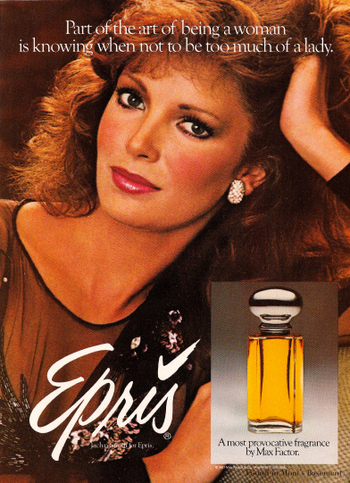
Belle of the Barnyard: Max Factor Epris


If I'd been looking for a spokeswoman in the eighties, and had a sultry perfume to sell, Jaclyn Smith wouldn't have been my first (or second) choice. While not exactly strawberry shortcake, she was never really the let's get right into bed type. Had I seen the Jaclyn-centric ad for Epris before smelling this 1981 Max Factor fragrance, I doubt my curiosity would have been triggered. Fortunately, I found a mini at some antique store last summer, traveling cross country with my mom (I don't advise this, by the way, unless you can keep your travel time down to under five hours or you're going convoy style in separate cars).

Until a week ago, I enjoyed this mini periodically but had no idea what it was, and much as I liked it, I didn't really investigate. I don't think I even checked the bottom of the bottle, where the label indicates the name. I assumed it was some Youth Dew era oriental, a one off that didn't make a wave (though it clearly should have) and barely made a dent in the mass market culture of suburban perfume lovers. At some point I even thought it might actually have been decanted from a larger, more recognizable fragrance by another traveller who, like me, needed some back up on the road. Who knew Epris was listed on Fragrantica all this time, or that I could have very easily looked into it before now?

Fragrantica lists Epris as a chypre floral. My immediate thought, reading this, was that if Epris is a chypre floral, Bandit is a fruitchouli in a faceted pink bottle. Epris doesn't even smell like a floriental to me. It's straight up balsamic oriental, with the usual suspects hiking up their skirts: patchouli, spices (clove, clove, and clove) and a generous scraping of civet and castoreum. It has a leathery feel instantly, rather than drying down to one, and while there are florals in the mix, as in Youth Dew, they've obviously been told to sit down and shut up. This fragrance wants to get horizontal, and it wants to get horizontal now. After gymnastic somersaults through spiced amber and barnyard, it gets a little powdery in the late dry down, as if to say, "Yes, that's my bosom you're smelling."

"Maybe your mother never told you," begins the television ad, "there's more to being a woman than minding your manners." You might easily assume, hearing Jaclyn Smith say this, that she's just sucked on helium. Maybe it's the quality of the recording in the version I watched. Either way, as with the designation "chypre floral", there's a real disconnect between the way the fragrance is made to sound (girly) and the way it actually smells (far end of post pubescent: pun intended). "Being a woman means sometimes taking the first step first," Jaclyn continues, after introducing herself in a sequined, mostly sheer black dress reclining on a plump leather sofa. Again, I would say leap, not step, because Epris is clearly an attack mode type fragrance, with a physical vocabulary ranging from pounce to pulverize.

Epris, says Jaclyn, is a fragrance that understands this "first step first" thing. "Epris is a little unsettling; a little disturbing. Epris is a most provocative fragrance. If mama never told you, I'll tell you: Part of the art of being a woman is knowing when not to be too much of a lady."

Whatever the tone of her voice, at least the dialogue speaks truthfully about the perfume. While the initial impression of Epris is along the lines of Youth Dew, it soon takes a slight but hard left turn toward Tabu, putting itself in park somewhere in between. Even in an era characterized by bold, forceful constructions, Epris was something of an oddball, looking back lustfully not just to Youth Dew (1953) and Tabu (1932) but to one of my all time favorites, Bal a Versailles (1962). It dives straight down to patchouli and animalics without bothering to ask you if you mind. There's that kind of confidence in it. It's on the prowl and thanks you very much for letting it out of the bottle to get the ball rolling, but no time for niceties. It don't mind if it do.

There's a taste for this kind of thing, and not everyone's salivating over it. I'm grateful, because it's scarce online, unless you want to stock up on minis until you have something approximating full bottle. I'm impressed with everything about Epris - the fact that Max Factor produced it, its tenacity, its husky attitude, its uniqueness among its eighties peers as an old school, unapologetic oriental. It's been a long time since I smelled something this good, and I was happy to find a seller online who was offering two one ounce bottles. How much do I like Epris? Better than my favorite Serge Lutens fragrance (a tie between Cedre and Arabie, in case you're wondering). Once again, I'm reminded that some of the most satisfying fragrances have been sold at the drugstore, for a steal, and they didn't even have oud in them.

Thursday, September 8, 2011

Tabu: Things Don't Happen the Way They Used To


I don't imagine the Tabu you get at your local drugstore is anything but a remote facsimile of the original.  And how could you expect it to be - at roughly fifteen dollars?  I suspect Tabu was once something closer in spirit to Muscs Kublai Kahn by Serge Lutens, and in fact when I smell many of the Lutens fragrances I'm reminded of the way I've heard vintage Tabu described.  I think of Francis Kurkdjian's wonderfully strange and smoky Absolue Pour le Soir, a raunchier Chanel Coco, Le Labo's Patchouli 24.  The current version of Tabu is a much paler cousin of these, but I like it the way I like other simple things that don't cost me too much, with a peculiar kind of affection I wouldn't afford it at a steeper price.

Though Tabu's creator, perfumer Jean Carles, was known for doing much with little - and by little I mean cheaply, because from all accounts Tabu had everything but the kitchen sink in it - he was like many great perfumers a master of finding the right combination, the most radical alchemy, of these various ingredients, and what's missing from the modern formulation of Tabu, aside from high quality materials, is that careful alchemy.  Many of the things which made Tabu striking in its original form are still essentially there - the patchouli (and how), amber, resins, spices - but much more crudely combined and calibrated.  And the ingredients most crucial to its scandalous appeal - natural musks and civet - have been replaced with synthetic alternatives and their dosages diminished for the tastes of the modern consumer.

Talk to anyone who remembers early Tabu and they will tell you that a certain kind of woman wore it and was known for wearing it.  Tabu was truly, at one time, the kind of perfume synonymous with, if not easy virtue and illicit behavior, then a certain regard for pleasure and candor.  Recently I talked to a woman about the perfumes the women in her family once wore, and they broke down into pretty broad, easily identifiable categories.  Her aunts wore Youth Dew, Marie Becker body cream, White Shoulders, and Tabu.  A floral, White Shoulders is really the far opposite of oriental Tabu, suggesting a traditionally femme respectability.  Tabu, in this woman's family, was shorthand for recklessness and maybe carefully judged abandon, at a time when female abandon necessarily courted disrepute.  Tabu was, it seems, the scent an animal gives off to the opposite sex, indicating anything from availability to the need for caution.  Rumor has it that the brief Carles was given for Tabu instructed him to create "a fragrance for a whore."  Copy for one of the ads (pictured above) called it "the forbidden fragrance".

Tabu was released in 1932 and was said to contain citrus, spices (of these, predominantly clove), jasmine, narcissus, rose, ylang-ylang, amber, resins, civet, sandalwood, and patchouli.  Rest assured it contained that and much more.  But that was the picture painted for the consumer, who probably only needed to hear patchouli, civet, and spices to ascertain the fragrance's carnal agenda.  This particular cocktail would have heated up nicely as the skin did, meaning that ardor could be expected to generate something like a feral frame of mind.  Today's tamer version still has sensual, if not sexual, warmth, but virtues and sexual mores have shifted and expanded and are more elastically defined now - more often than not the average consumer has seen if not done it all - so it's difficult, based on drugstore Tabu and our contemporary climate, to imagine the kind of scandal the perfume once implied.

I've found eau de cologne versions most regularly, but did find an edt not too long ago.  These formulations smelled similar, but I prefer the cologne.  It lasts as long and doesn't feel quite so polite.  I want to get as much roar as I can out of this aged beast, and the cologne is, for me, slightly more ragged and robust.

Friday, July 17, 2009

Sonoma Scent Studio Tabac Aurea

A while back, Abigail raved about this little wonder, and I made a mental note to check it out. I don't know what's going on with Sonoma's website--the till is down, so you can look, essentially, but you can't touch--and some of you are going to be frustrated after reading this review, because I have high praise for the fragrance, but look at the bright side: you can't possibly know how truly wonderful Tabac Aurea is, and what you're missing, until you get your hands on it, and even then the exact nature of its powerful appeal will elude you.

For Abigail, Tabac recalls vintage fragrances--their complexity, attention to detail through depth and drama, the rich, dovetailing stories they tell. Her presiding image for the fragrance was Bette Davis. Funny how things work, because I'm picturing Robert Mitchum, whose sharp-angled cheekbones are trying to make something feminine out of what is clearly butch-saturated stock. Clearly, Tabac Aurea is unisex, gender-friendly, but in a sea of bland, interchangeable, unimaginative masculines, I'm apt to claim it as one for the boys. Then too, Tabac recalls some of my favorites: Histoires de Parfums 1740, Parfum d'Empire Fougere Bengale, Annick Goutal Sables. In all of these, immortelle plays a big role, and though there's no indication that Tabac Aurea even contains immortelle, the argument could be made that I simply love the kind of fragrance Tabac resembles.

That isn't giving what I'd include in my list of the top ten masculines of the last decade much credit, now is it? And yes, Tabac is that good. It's certainly the best tobacco fragrance I've ever smelled, but it's more than that, possessing the kind of magic words fail. Looking at the facts alone--persistence, projection, quality of materials--it blows Sables off the table. Sables is gorgeous, if you have something on hand to apply thirty minutes later, to console you once it has vanished. Tabac Aurea lasts all day on my skin, has the kind of diffusion that makes my presence beg questions from those I come into contact with (what...is that? Are you...is that...cologne? Where did you get that? What is that called? Will you have sex with me? Would you mind doing it right here? Let's get married--just for the next ten minutes? Actually, can I just have that smell, so we can have sex alone?) and it is abundantly clear, from the moment you first smell it, that Tabac's creator refined and refined again in her effort to achieve such a careful, unlikely balance.

While it falls within the olfactory range of 1740 and Fougere Bengale, Tabac distinguishes itself enough that it's worth having all three--if, like me, you're that obsessively inclined, and worried about redundancy. Tabac speaks to those fragrances the way one smoky-voiced singer speaks to another, through tone and texture, but the music and personality are unique. The vetiver in Tabac imbues it with qualities neither 1740 nor Bengale possess, moving it farther away from the insular combustion immortelle gives the former, the sense that 1740 has a lot on its mind, is troubled and needs some time to think about it. 1740 harbors things, relishing its drama. To 1740, Tabac says, Hey, lighten up; it might never happen.

Which isn't to say Tabac is happy-go-lucky; just that it doesn't brood. Like Fougere Bengale, which uses lavender in a similar way, as if to clear its head, Tabac loosens up with vetiver. Unlike Bengale, which comes on like the most intoxicating (or, okay, I'll give some of you this: nauseating) spice cabinet this side of reality, Tabac has a persistent but subtle tangy aspect, a barely there fruit accord which operates similarly to the cassis bud in Iris Bleu Gris, subverting what might otherwise be an austere, stand-offish disposition. Tabac is foody, but more savory than sweet. It has woodsy undertones to it. Clove, tonka, labdanum, leather. Need I say more? If you're into this sort of thing, I'm guessing not.

I've resorted to comparison in an effort to convey an inexplciable mystery. Shame on me. Stupid, I know--but to do otherwise I would need a vocabulary which hasn't been invented yet. I love this stuff.

Sunday, March 15, 2009

Will the Real NORELL Please Stand Up?


When I was a kid, Norell was the kind of perfume I expected to see out on my grandmother's dresser, displayed on a gold and glass tray. I wonder what it was about the bottle, or the perfume, that made it seem so formal, made it such an exhibition piece. I remember it being incredibly rich, with smoky galbanum notes and a luxuriant complex of spiced musks, placing it alongside other old time heavies like Dioressence, Miss Dior, Youth Dew, Aliage, and Arpege. I couldn't imagine anyone wearing it without a dinner date or a gala to attend.

Now that I know what was in Norell--in it back then, at least--that doesn't seem like such odd company to have kept. At the time, I knew nothing about galbanum, and really didn't identify it as a green, coniferous note with mentholated overtones. Instead it made perfumes like Miss Dior and Aliage seem impossibly heady to me. Youth Dew was heady too (and made, or so some say, by Josephine Catapano, the same nose who created Norell and Laroche's Fidji). Youth Dew and Norell share a balsamic density which made them seem interchangeable in some way, a dignified secret passed from one bottle to the next. They were the kind of perfumes old women wore to create a line of defense against a younger generation's lack of manners, good breeding, and class distinctions.

Over the past several weeks I've tried various reformulations and concentrations of Norell, all of which, though fairly different in many respects, open on a strong gust of galbanum. Where they differ most is in the dry down. The latest reformulation ($5.99 an ounce at Perfumania) opens with sharp galbanum, radiates quite nicely, then promptly collapses into a muddled, if persistent, amber. Given how low much higher and mightier ilk have stooped during the past decade, fudging around with their formulas and their ingredients, it's a wonder a drugstore standby like Norell hasn't descended altogether into hopeless mediocrity. Just don't go comparing it to the original. Lucky for you, that would be hard to do, as the original is hard to come by, and after so many versions, who would recognize it?

The fragrance was released in 1968 by Norman Norell (he dressed Lady Bird Johnson, Babe Paley, Lauren Bacall, the socialite Hope Hampton and Dinah Shore, among others) and was sold to Revlon in 1971 for 1.25 million. The Revlon formulation would have been what I snuck out of my stepmother's medicine cabinet in high school: still rich, still smoky, opaque and full of stark contrasts, like a strand of pearls against a black wool evening dress. It still had something of a reputation to uphold. In the late nineties, the fragrance was sold to Five Star Fragrances, which also owns the rights to Royal Secret, another perennial el cheapo balsamic bomb (not necessarily a bad thing: see Youth Dew). An attempt was made to market the fragrance back to the young women who must have smelled it on their own mothers and associated it with class, luxury, and a certain overall way of life, a fantasy of affluence. Faye Dunaway, a woman their generation watched mature on movie screens, was made the face of this new good old Norell. The Dunaway formulation smells, like the others, of galbanum up top, pungently green, but this is something of a come on, as the underlying content is lacking in substance and devolves into a hollow, tangy mess; not quite green, not remotely smoky, and nowhere near rich.

It seems to me the closest I'll get to the old Norell is the bath oil, judging by recent revisitations. At about 10-20 dollars an ounce online, the oil is a real bargain, if not an outright steal. For this you get the smokiest, greenest, most balsamic iteration of the lot. It goes on rich and it dries down that way, remaining complex, retaining its density. It smells wonderful, and relates clearly to Youth Dew, which is also available, also smoky and warm, as a bath oil. I imagine the bath oil is close to the pure parfum, though I haven't tried the latter. Norell also comes in a colonge spray. I haven't tried that either. The pure parfum is also dirt cheap, all things considered, and might be worth a shot.

The Scented Salamander lists Norell's notes as: galbanum, ylang ylang, carnation, clove, cinnamon, coriander, vanillic cardamom, musky vetiver, oakmoss, and myrrh. I can't dispute any of these, nor can I smell them individually. Norell is a concerted effect and feels, like Youth Dew, highly concentrated. Myrrh makes rational sense, as does clove and carnation. There's a spicy radiance to Norell. A New York Times Magazine article from 2001 discusses how complex those old perfumes were. Catapano characterized them as "long, like a treaty." She never understood why Norell didn't remain more popular than it was. Maybe she did understand and simply refused to accept the obvious. Comparing Ellena to Norell, for this generation, at least, is like trying to convince someone to wear a heavy boucle coat instead of a gauzy linen wrap on a Spring afternoon.

From the Times article: "Paul Austin, Quest's vice president of marketing and new business development, says that when Norell appeared, it had a lot of presence and character, unlike the lighter florals in America. Perfumers today could never get Norell past the focus groups. 'The green top note is a tough sell,' admits [perfumer Rodrigo] Flores-Roux, referring to the pow of galbanum, the resinous grassy odor that first hits the nose. Austin adds that American women have an aversion to the clove and spicy floral notes at its heart. The aldehydes supported by ylang-ylang dates the fragrance, putting it in a class with Chanel No. 5..."

"It's a silly world," Catapano said, considering what had become of her favorite creation. "It's the best fragrance. And nobody buys it anymore." Chanel has had reason and the wherewithal to reformulate Chanel No. 5 for future generations, translating the fragrance according to changing times. Norell has had no such good fortune.