I have many Chanel fragrances--among them, some of the Exclusifs--and even make enthusiastic excpetions for the ones generally considered sub par or sell out, like, say, Allure Sensuelle, which is no Mitsouko but hardly chopped liver, either. I appreciate the quality and the subtlety of Cuir de Russie and Coromandel, could practically drink the gin-soaked iris splendor of 28 La Pausa with a straw; I appreciate Cristalle though I never wear it and only smell it occasionally to remind myself why; have tried to climb the steep, slippery wall that is No. 5, always falling back on myself, admiring but ambivalent. No. 19 is one of my all time favorites, and I own not one but four bottles (two Eau de Parfum, a large splash toilette, and a spray bottle). I do see why the young ladies love Coco Mademoiselle; though, like a lot of other things they dig (belly rings, jewel-encrusted cell phones, thongs, butterfly tattoos on the hip bone) it's simply not for me. Pour Monsieur makes my eyes roll back into my head for the ten seconds it lasts. Antaeus makes me weak-kneed, and I looked forever trying to track down a bottle.
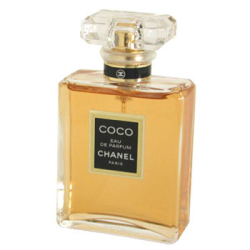
But the Chanel I love the most is the easiest to find, and I can't explain why I love it as much as I do. Coco came out in 1984, the year I started high school. My sister had a huge bottle of it, and whenever she came home from college, I snuck into the bathroom to smell it. I want to say that at one point I spilled some of it--enough to get her attention. I knew Chanel was chi-chi at the time but it was so mass market that I must not have thought much about the price, or what spilling "a little" would mean to the pocketbook. I spent a lot of time in the bathroom as a child, for a variety of reasons I won't get into, but some of that time was spent with perfume. It was the only safe opportunity for a young boy/man to smell it, and a sense of shame, gender stuff, came with the territory, which is why, I suppose, I'm so resistant to received ideas of masculine and feminine in fragrance as an adult. I now own most of the perfumes I smelled in my mother's and sister's bathrooms; among these, Ted Lapidus Creation, Albert Nipon, Bill Blass, Private Collection, Paloma Picasso, Ysatis, Anais Anais, Magie Noire, Halston, Paris, White Linen. I didn't realize just how nostalgic I am until I started collecting perfume, which, for me, has been a lot like reassembling old family photos I somehow misplaced or scattered over time. Perfume holds keys to the past, creating doorways into memories and buried feeling, reassembling long lost rooms around you.
Coco smelled different to me when I first re-encountered it after all those years, and I don't doubt things were tweaked and removed. Natural musks would have made a significant difference, I imagine. To me, it has less depth, which is probably just as well; the Coco I remember was deep enough to get lost in, with a dark, resinous quality that seemed more like something you'd pour on a waffle than spritz on your skin. Who knows what the addition of civet would have done to what I smell now. The present Coco seems a little boozier to me, as well. That said, there are notes or accords in the fragrance that instantly transport me back to high school. Smelling it now, I can visualize the bathroom shelf it sat on and the cold tile underfoot as I stood admiring the bottle. Coco seemed very adult to me, maybe a little too adult. My sister in Coco was like Brooke Shields in Pretty Baby, diametrically opposed ideas of youth and experience walking hand in hand, all cleavage and dimples.
It was the first perfume released by Chanel after the death of Gabrielle, aka "Coco". Apparently, the fragrance was intended to evoke the opulence of Mademoiselle Chanel's lifestyle, though I can't imagine many really knew much about that iconic woman's private life at that point, beyond what had been carefully advertised. "Gilded mirrors and lacquered screens from Coromandel," is how osmoz puts it, which is perhaps a pull-quote. Jacques Polge, Coco's creator, has produced many Chanel fragrances since, many of them painting pictures, in liquid form, which depict some aspect of the private realm of Coco Chanel. Smelling these, one is meant to enter into a world of nonexistent memories: here is Coco reclining on her chaise in front of an Italianate marble fireplace. Here she is fitting a dress to a mannequin, a cigarette holder extending from her lips. Here is her backbone, her nerve, her audacity and good taste. Many of us have an image of the persona that is meant to be Coco Chanel, and the memories we build around Chanel perfumes mingle with this, fusing in complicated ways. When I smelled Coco at the bathroom sink, my sister became some sophisticated amalgam of the young woman I knew, Ines de la Fressange, and Coco Chanel, a glamorous, makeshift persona I then grafted onto myself by standing in her place before the bottle.
I swear there's carnation in Coco, or maybe this is the combined and accidental effect of clove, peach, coriander and rose. The opening of the fragrance is practically succulent. Chalk that up to the presence of damascenones, which are known for imparting rose, stewed fruit and vaguely nutty qualities to perfume. Like Opium, Coco explores the imaginative concept of the "oriental", but in its fuzzy, diffuse warmth it comes closer to Cinnabar than to Opium's sharp, structural precision. Coco smells a little like spiced chocolate as well, reinforcing the gourmand properties of its nectar notes and literalizing the name.
Add to this a hint of carbonated cola and honeyed, savory tobacco. There is said to be sandalwood and amber in the mix. Coco was an answer song, issued during the advent of the late seventies oriental; specifically, a response to the hegemonic twin tower shadows cast by Opium and Cinnabar. Coco was intended as an extension of the Chanel brand into the high-stakes pursuit of this ubiquitous consumer trend, and Chanel hoped to emerge from those tall shadows with a hit of its own, an usurpation and a declaration of purpose, at once rebuttal and recalibration. Smelling it, one recognizes Coco's provenance. It smells unmistakably of the house which produced No. 5 and No. 19, whereas Cinnabar and Opium might understandably be confused for one another. If anything, Coco looks farther back, to the gilded peach fuzz of Mitsouko. Where other orientals fade into a murky, oakmoss-subdued languor, Coco charges out of the bottle and straight through the day, most decisively there until, quite suddenly, it isn't anymore. I sometimes think I prefer it over all the Chanels because of this confidence, which seems so masculine in its way that no boy should have to hide himself away to enjoy it.


